Quantcast
Showing posts with label cybils. Show all posts

Two Recommended Native American Non-fiction Picture Books


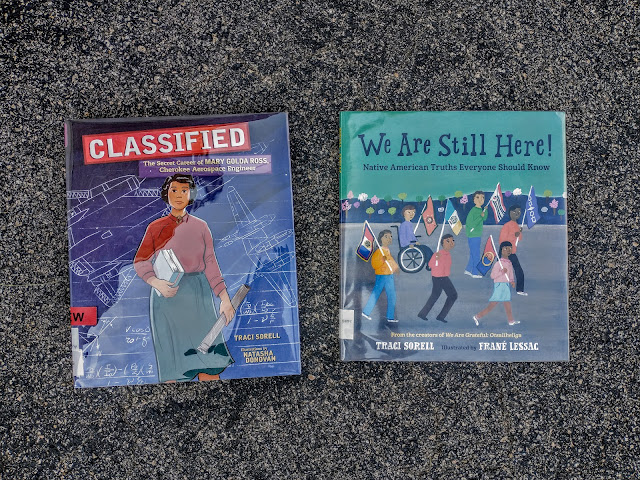
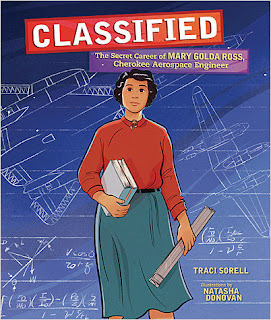
Classified: The Secret Career of Mary Golda Ross, Cherokee Aerospace Engineer by Traci Sorell, illustrated by Natasha Donovan.

This is a picture book biography of Mary Golda Ross, who grew up with a strong connection to her Cherokee tribe. As a woman in the 1920's who lived until 2008, her love of math and eventually engineering was uncommon, and she helped blaze a trail for other women and Native Americans. 

From the first page, Classified focuses in on four Cherokee values: gaining skills in all areas of life, working cooperatively with others, remaining humble when others recognize your talents, and helping ensure equal education and opportunity for all. I love how the material in the back of the book shows the syllabary, transliteration, pronunciation and English translation of each of these values. In my review here I thought of summarizing the four values, using one word each, but that doesn't really capture what the actual, translated values are. It feels more true to share the direct translation. 

Classified by Traci Sorell
Sprinkled with interesting truths about Mary Golda Ross, this biography tells us some of the work that Mary accomplished -- but much of it is still "classified." This made it a little bit difficult for me to remember the book, when I read it among a stack of contenders, and after it had been a little while between readings. What was it she did, again? There is no "one thing" that the book gives her complete credit for. However, this is the big truth -- our accomplishments are cooperative, and Mary Golda Ross apparently understood that well. Upon re-reading the book, I realized it's not the sort of picture book biography that is meant to tell you about one person so much as it is meant to teach you, through one woman's example, these four Cherokee values that she lived by. 

On my first read? Meh. On my reread? I like it a lot!

The illustrations are well done, and add to the understanding you get from the text. Simple, but not oversimplified, colorful yet still realistic, the art isn't showy, but it is solidly helpful. The backmatter of the book includes a timeline, source notes, bibliography, author's note, and the aforementioned four Cherokee values. 

This book was shortlisted for the Cybils Award in the Middle Grade Nonfiction (ages 8-12) category, and I think ages 8 and up is about right for it.  I would recommend it to kids parents and teachers who are interested in learning about other cultures and the core values that drive us! Bonus, you will also learn about women in STEM.


We Are Still Here: Native American Truths Everyone Should Know by Traci Sorell, illustrated by Frané Lessac

Another Cybils nominee in the elementary nonfiction category, We Are Still Here reminds me of a young adult graphic novel I read for the Cybils called This Place: 150 Years Retold. This Place won the Cybils award (for Young Adult Graphic Novel) back in 2019. It was so good. I can't believe I didn't review it here! But I helped to write the review of it posted here. Anyway, We Are Still Here gives readers a lot to unpack, and I was grateful for the context that I had from previously reading This Place

The premise of the picture book, We Are Still Here, is that each page is the project that a student has created to teach classmates about some aspect of indigenous people's history that still affects life today. There are twelve topics covered and they range from assimilation and allotment to language revival and sovereign resurgence. The text of We Are Still Here has very high vocabulary and a lot of information on each page, but the repeating refrain "we are still here," ties each page to the next. 

Hand-painted art sets the scene for each "presentation" and features a lot people -- presidents of the United States, children at school, and people on the street just to name a few. 

Backmatter is robust in this book, and includes more information on each of the twelve topics, a timeline from the 1870s to the 2007, a glossary, sources, an authors note. While I feel like this book packs a lot of information in, it also gives readers resources for further learning so that they can delve deeper into each of these topics. 

I really appreciate that repeating refrain which titles the book: We are still here! The more I have learned and the older I've become, the more I realize the truth of this and the obstacles that indigenous people have faced. I still have a lot to learn. When we moved to Connecticut, I enjoyed learning that "The Last of the Mohicans" -- a movie/book I've never watched/read -- was wrong. The Mohegan tribe is still here! 

I recommend this book for older elementary school kids and as a great resource to older students and adults. I have to agree with the books subtitle, it contains history that everyone should know. 

Four Fabulous New Non-fiction Picture Books


Ok friends, get your library cards ready, because today I'm telling you about more of the awesome finalists for the Cybils award that I got to read this year! They're so good!


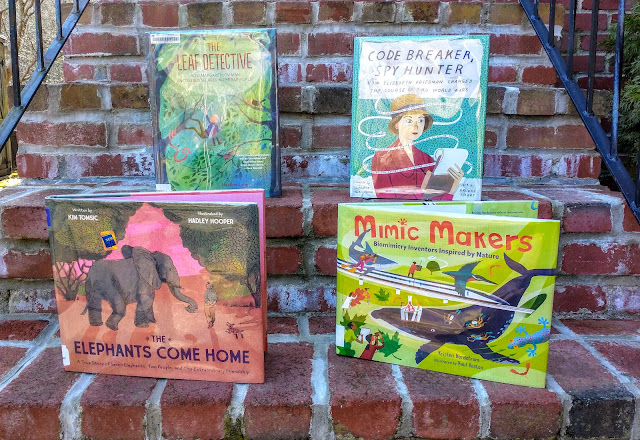
Mimic Makers: Biomimicry Inventors Inspired by Nature by Kristen Nordstrom illustrated by Paul Boston

Mimic Makers was a big hit at my house. I think all four of my kids (ages 13, 11, 8, and 4) read all or part of it. 

I know that biomimicry is a topic discussed in first/second grade classrooms because I helped my daughter with a project about biomimicry when her school was online during the pandemic. So, when I opened this book, I hoped for some fresh examples. The shinkansen is a well-known example and I was starting to roll my eyes, but then every other example in the book was something I had NOT heard about and found absolutely fascinating.

The information is presented with a clear structure, with human interest elements, and is just so fascinating that I found myself bringing the inventions up in everyday conversations I was having. I love the way inventors from around the globe were interviewed! And, you can tell from the stories shared in the book (as well as her backmatter) that the author interviewed the inventors personally.

Meticulously researched! Fabulously written! Broad appeal! When I finished reading this book I immediately wanted to gift a copy to my daughter's teacher. (And don't tell all the other books, but I pitched this one as my personal favorite to our panel of judges.) 


I really enjoyed reading this book! Of the books on the Cybils Elementary Nonfiction shortlist this year, this was the book I was most excited to read to my family. It is a beautiful story and it did make my voice catch when I read it aloud. 

The Elephants Come Home has broad appeal. My 4 year old was very interested in it. When faced with all the nominees, a 9 year old friend of the family picked it as the most appealing cover. My kids and Jacob all read it or listened to me read it. I myself loved it. The first page gets a reaction! It seems like a love-it-or-hate-it beginning and it does hook you in. Then, the writing is crystal clear. You’re guided seamlessly through the story, which is a beautiful human and animal connection story! There’s no doubt in my mind it has both kid appeal and literary merit. 

The one thing that gives me pause is the book's treatment of race. The only time race is overtly mentioned in the book, it doesn’t put Zulu people in a positive light. Race is depicted in the illustrations, but the people of color in the book are not named. When I read it aloud to kids now, I plan to point out some of the illustrations and wonder aloud what the names of the people of color are. I think they were purposely left off to keep the story simple and the writing very crisp. The writing is crisp, but it does anonymize people of color. Despite this, I still highly recommend The Elephants Come Home.  


This book was the first of the Cybils finalists that Jubilee (age 8) read this year, and she quickly asked me if I had read it yet. "It's really good," she said. 

Code Breaker, Spy Hunter tells the story of Elizebeth Friedman, who broke SO many coded messages  and invented and taught code breaking in WWI, WWII and beyond. Her work has only recently come to light because it was kept classified for years. 

Jubilee and I both liked the page that tells about Elizebeth testifying in court and proving the opposing counsel wrong when they said she was making up the answers to the decryptions she had solved. Victory! Jubilee also liked the story of her sousing out the solution to a code that involved code words and suspicious letters about dolls. I liked the tidbits about Elizebeth's personal life and dreams - the mysterious party hosted by the Friedmans in which invitations were sent in code, and the priority that Elizebeth put on her family and home life. 

The illustrations are done in colored pencil (or colored pencil style...it's so hard to tell these days with digital art making huge strides!). The images obviously contain hidden codes that it would be super fun to try and decipher. Sadly our copy was overdue at the library all too soon! We did crack the one cypher in the back of the book that is meant to be cracked, but I have a feeling that there are many more hidden messages in the illustrations.

My book club read The Woman Who Smashed Codes, a biography of Elizebeth Friedman, last year. I didn't finish it in time for our club meeting but found it interesting and recognized a lot of the details of Friedman's life from that book. However, The Woman Who Smashed Codes has over 400 pages in which to tell her story. I think it spoiled me a little bit, because I felt like the picture book left too much out. But, that's just a personal problem. 


Multi-layered digital art made this gorgeous book stand out among the forest of options, and it was a close contender for the winning spot. 

The Leaf Detective tells the story of Meg Lowman, "Canopy Meg," as she is sometimes called. She revolutionized the way that trees are studied, invented canopy walkways, and educated countless people about trees and how and why to protect them. 

One thing I loved about this book was that aside from the main text, on a leaf on each page, new insights and facts added to the narrative. For instance, before Lowman revolutionized the field, did you know that most scientists studied tall rainforest trees by chopping them down to see what the top looked like? Or sometimes they gassed the trees so that all their leaves would fall and they could study the leaves that way. I mean, that's mind blowing! Meg sewed herself a harness and hoisted herself up into the trees to study them without killing them. You go, girl!   And her work as an inventor and educator is no less inspiring, but I'll stop ranting and let you read the book.

If I read a picture book biography, I want it to impress me with facts and research as well as story and have the answer to that all-important question that I ask myself as I pretend to be a grade school boy who could be playing video games right now, "Why should I care?" Check, check, check. The Leaf Detective was a great read. 


Cybils Winners!


I'm so excited to announce the winners of the Cybils award for Elementary & Middle Grade Nonfiction!

This year I served as a Round Two judge on the Elementary & Middle Grade Nonfiction panel for the Cybils - Children's and Young Adult Bloggers Literary Awards. The awards have been going for 16 years now, and I have been volunteering in some capacity for the last 14 years -- wow! 

I have to say that I felt like the entire shortlist for the Elementary Nonfiction category was really strong. As I told my fellow panelists, I wouldn't be sad if any of these books won. I'll be reviewing each of them in the coming weeks. The Middle Grade Nonfiction category had many strong contenders, too!

Books earn the Cybils award by being exemplary in two areas: Kid Appeal and Literary Merit. We discuss and award books on these two criteria. Do kids like the book? And is the book good, from a literary standpoint?

Round one judges read all the nominated books published in the past year (October of the year prior through October of the present year) and evaluate them on Kid Appeal and Literary Merit. They narrow this list (maybe 150 books or more) down to 5-7 titles. This is the shortlist. 

Round two judges narrow the shortlist in each category down to the single winner! And that's what we have here for you today. The BEST nonfiction book for kids ages 5-8 in the Elementary nonfiction category, and the best nonfiction book for kids ages 8-12 in the Middle Grade category.

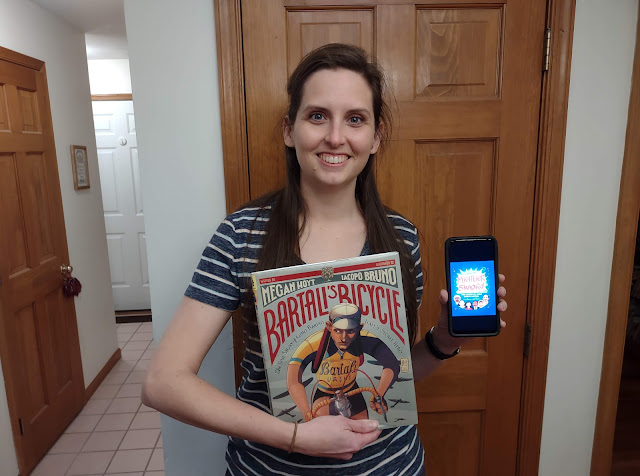
written by Megan Hoyt illustrated by Iacopo Bruno

This is a picture book biography of Gino Bartali that is so beautiful and inspiring! 

As one of my fellow panelists pointed out, riding a bike is something kids can relate to in a big way, and that's what Gino Bartali was famous for . . . at least at first. When it came to cycling, he trained persistently and eventually won the Tour de France! But when Nazis invaded Italy, Gino became another kind of hero. He used his cycling skills to protect and preserve the lives of those around him. And the humility he exhibited throughout his life and despite his achievements is memorialized here. 

In deciding between Bartali's Bicycle and some of our other strong contenders, panelists talked about the gorgeous, dynamic illustrations of Iacopo Bruno. Guys, I know "we don't talk about Bruno," but this art is top notch! Each page conveys movement and has an interesting, fresh layout. 

Materials at the end of the book include a letter to readers from Gino Bartali's granddaughter, a timeline, and a full page of sources. 

Definitely give this book a read. As soon as I finished it, I thought I had better share it with the most avid cyclist that I know. I'm sure you'll find someone to share it with, too. When looking at a picture book, you have to consider, is an adult going to want to read this over and over? Is a kid going to want to read it? Bartali's Bicycle will definitely appeal to ages 5+ and stand up to repeated reading.


 by Rochelle Melander, illustrated by Melina Ontiveros

Mightier than the Sword was a little bit tricky for some of us judges to get our hands on! It was published by a small press, and so it wasn't available in my library. However, if your library has hoopla (kind of like the Netflix of ebooks and music for libraries?), then you can find this title there. And it is absolutely worth finding!

If I'm totally honest, I wasn't particularly looking forward to reading a bunch of bios of writers. It is really easy for this type of book to become same-samey. Maybe you turn to it for one person, but you'll never read it cover to cover. WRONG! I absolutely read Mightier than the Sword from cover to cover and it was not even a chore. It was delightful! 

For one thing, the writing is engaging and fantastic. (Thank goodness! To have sub-par writing in a book about so many writers would be embarrassing.) Each person's story is brought to life with interesting details and relevant quotes. And then, if that wasn't enough, there are little sidebars or cameos of other relevant writers in each chapter. The organization of the book made it really interesting to me, as well. Each chapter is a writer's biography and they are ordered by year of the writer's birth. So, the book as a whole becomes something of a history book, as you go along. 

I'm reading A Little History of the World by E.H. Gombrich with my daughter Jubilee right now -- we're just taking a chapter at a time on nights when we can squeeze it in. It's great. But honestly, I can't wait to read Mightier than the Sword with her! She is going to eat it up. Especially because she has some aspirations to writing, and each chapter ends with writing prompts and suggestions. 

Another engaging facet of the book is the illustrations. Each writer and each sidebar gets a portrait by Melina Ontiveros. For the names I didn't already recognize, it was fun to try to puzzle out who this person would be based on the small items included in their portrait. 

As a group, we round two judges loved that it was a diverse group of writers highlighted. Not only were writers from a variety of homelands and races, but also diverse through time, as I've mentioned, and they are diversely famous -- some of them are famous for being writers (Shakespeare is profiled), but others are more famous for other work they've done (Florence Nightingale, for instance). And still others of them weren't already known to me. Mightier than the Sword made learning a pleasure. 

One of my fellow panelists was formerly a teacher and she was very excited about the potential for classrooms to use this book. It would be very easy to read excerpts, and of course the suggested writing activities would connect to teachers and students well, too. 

I hope winning the Cybils award for Middle Grade Nonfiction shines some more light on this book, because it deserves to be found! 

A full list of this year's Cybils winners in all categories can be found here

When Stars Are Scattered

When Stars Are Scattered by Victoria Jamieson and Omar Mohamed
National Book Award Finalist, Winner of Cybils Award (Elementary/Middle Grade Graphic Novels)

Omar and his brother Hassan live in a refugee camp and they have ever since they can remember. This graphic novel shows their life in the camp, Omar's schooling, Hassan's struggles because of his disability, and their relationships and ups and downs of life. 

Coming from award winning graphic novelist, Victoria Jamieson (known for the Newbery-winning Roller Girl and All's Faire in Middle School), I expected the book to be well written and drawn, and it was. It's also an amazing story, and we have Omar Mohamed to thank for that. There were definitely moments when my eyes got misty.

This book is well suited to the upper elementary and middle school markets. I recently read Walk Toward the Rising Sun, a memoir written for middle and high school students, and I found that one richer in details but it also had some swearing and violence that When Stars Are Scattered doesn't have. Each was well suited to its audience.     

Benjamin (age 12) also read When Stars Are Scattered, and says that it's good. He recommends it for fans of Home of the Brave by Katherine Applegate, which his class read in 6th grade. 

Speed Reviews of 5 New Nonfiction Picture Books

Today's reviews of non-fiction books are a little of this and a little of that, but all worth their salt. And they all need to go back to the library today, so it's a speedy review for each!

Rescuing the Declaration of Independence: How we Almost Lost the Words that Built America by Anna Crowley Redding illustrated by Edwin Fotheringham

Loved the illustrations in this one. It was definitely a cool story that I had never heard before. Stephen Pleasonton was James Monroe's clerk when he got an urgent message that the British were coming to attack Washington. Despite the possibility of it being a fake-out, and even though it took a ridiculous amount of work, he moved the records from his office in the State Department and kept them safe during the attack. The problem I had with this book was that Peasonton was given all the glory, even though it was a huge group effort. Still, a very cool story, well written and illustrated.


The Cat Man of Aleppo by Irene Latham and Karim Shamsi-Basha, illustrated by Yuko Shimizu

This gorgeous, meticulously illustrated book tells the story of Mohammad Alaa Aljaleel, an ambulance driver who stayed behind in war-torn Syria when his family and friends fled the country. With so many people gone, all the cats of the city begin struggling. Alaa finds a great sense of purpose in caring for the cats, finding a place for them, and eventually building a far-reaching service oriented community. This is an inspiring book, and my cat-loving son liked it, too. 


Who Will It Be?: How Evolution Connects Us All by Paola Vitale and Rossana Bossù

I found this one a little bit abstract. It wasn't until I read the backmatter and then re-read the book that I felt I understood what author & illustrator were going for. The book takes us through how we all have a common form early in our gestation -- fishes, lizards, foxes, ducks, humans, we all have very similar form in the earliest stages of life. I felt like I learned from this book, but it bothered me that the abstract art was also mixed with real but unfamiliar science art. I wondered which parts of the art were true and which weren't. The book is certainly informative and beautiful to look at. 


Nature Did It First: Engineering Through Biomimicry by Karen Ansberry illustrated by Jennifer DiRubbio

Since biomimicry was an area of focus in my first-grade daughter's classwork, I was interested to read this book. It introduces 7 concepts from nature that people have imitated to their advantage. Each has a page with a poem on it, and a page with facts and information. The poems were alright. The informational pages were cool. Each info page had 4 paragraphs and the last one was devoted to how humans have engineered this nature concept. I think I would have liked more on that, and less poetry, but it's still a great book to use if you're studying biomimicry. The watercolor illustrations were detailed and pretty awesome. 

You're Invited to a Moth Ball: A Nighttime Insect Celebration by Loree Griffin Burns photographs by Ellen Harasimowicz

The step-by-step instructions in this book make it seem both possible and fun to host a party in which the main attraction is moths. The photos are great, and show set-up as well as many amazing moths. The conversational tone of the book  makes it easy to read in one sitting and the big headings would make it easy to flip back through the book as you were setting up your own Moth Ball. Recommended for the curious and scientific ages 8 and up, I'd say!

2 Commendable New Biographies in Poetry

 In my reading for the 2020 Cybils Awards for Non-fiction, I've read a lot of biographies so far. These two stand out for being written well written in poetry.

Yusra Swims

I think this may be one of the most moving picture book bios I've read this year. It tells the story of Yusra Mardini who was training to swim in the Olympics when war forced her to flee her country. The spare text with a driving, repetitive rhythm does a great job of moving the story forward quickly. The predictable rhyme scheme is a great foil to the unpredictability of the story. You could read the book in a minute or two!

But the pictures and the word choice keep you on each page longer, engaging your brain to think about what this story means. And they've brought me back, several times. This is a book I can see working well for many, many ages. It could seamlessly fit in a high school classroom. With discussion, it could work for the very young. A short page of backmatter, "About Yusra Mardini" adds some interesting details to the story. This isn't a book I'll soon forget. 


The Superlative A. Lincoln

This book was a lot of fun. Eighteen poems describe the life and work of Abraham Lincoln, each accompanied by an illustration and some explanation. Each poem has a superlative title: Best Lumberjack, Greatest Speech, Most Likely to Tinker, etc. I found myself discussing this book with my family at the dinner table and impressing all with my little-known facts about President Lincoln. The poetry is colloquial, even conversational, and very accessible. I could see third and fourth graders enjoying this book on their own. 


7 New Picture Book Biographies


Here's another bunch of new nonfiction books I've been reading for the Cybils Award this year!  

Fred's Big Feelings: The Life and Legacy of Mister Rogers by Laura Renauld

This book would be a good fit for an elementary school audience that is familiar with Mr. Rogers Neighborhood. The book talks about Fred Rogers life growing up, his journey into and work with television, and his legacy. Throughout the book, words that name feelings and emotions are italicized.  As far as backmatter goes, just an author's note comes along with this one, no photos of Fred Rogers or timeline of his life. It's a book about feelings that also happens to be about Mr. Rogers, rather than the other way around. The art and color in the book do a good job of complimenting the text and evoking mood. 

Having watched the recent Mr Rogers documentary Won't You Be My Neighbor, I didn't learn anything particularly new about his life from this book. Still, if I were teaching about feelings and emotions, this would be one to reach for. 


Kamala Harris: Rooted in Justice by Nikki Grimes

This picture book biography of Senator Harris has a side story: A narrative about a first-grade girl, Eve, who is annoyed with a classmate who said "girls can't be president." She tells her mom about the situation and her mom tells her about how Kamala Harris hopes to be president someday. As the biography tells about Kamala Harris's upbringing and how she got into politics, Eve and her momma speak in italics at the bottom of some pages. I wondered if this would deter some readers, but it worked really well for my second-grade daughter. The book preaches hard work and perseverance and ends the biography portion with "Kamala Harris is still writing her American story." A little bit of humor from Eve and her mom close it out. A timeline and sources can be found in the backmatter, and the timeline adds salient details that didn't fit in the text. 

I have read Grace for President innumerable times to my daughter, and this book reminded me of that one. They make a nice pair. If you're looking for insight into the background and motivations of Kamala Harris, this seems like a good place to start. 


Dinosaur Lady: The Daring Discoveries of Mary Anning, the First Paleontologist by Linda Skeers

Having never heard of her before, I found it fascinating to learn about Mary Anning and her discoveries near her home. We learn about Mary from her childhood to her adulthood, and the book touches on the discrimination she experienced because she was a woman in the early 1800s. The amount and quality of fossils that she discovered, and the depth of her curiosity and knowledge were impressive.  The book was written well for an elementary audience and the backmatter added to the understanding for older readers. Great timeline, too. This was one I caught my kids reading on their own.


Lizzie Demands a Seat!: Elizabeth Jennings Fights for Streetcar Rights by Beth Anderson

The book details an incident of racism when Elizabeth Jennings was refused a seat on a streetcar in New York City in 1854. It then takes us through the aftermath of that incident in her community, to the court where her case was heard, and to her community and the country after the verdict.  

This book was interesting. I know of Rosa Parks, and I was blown away by Claudette Colvin a few years back, but Elizabeth Jennings' name was new to me. Her story is compelling and the book adds to the overall story of civil rights. I didn't particularly care for the illustrations, done in watercolor, but I loved the author's note (which included some photographs and lots of extra facts). 


Feed Your Mind: A Story of August Wilson by Jen Bryant

I didn't know who August Wilson was, and this book took a little while to get around to telling us what August Wilson did, so that was an interesting experience. The washing machine story at the beginning of the book is an excellent example of the kinds of discrimination that make life difficult for People of Color. Over all, the book was very interesting, and the way August Wilson educated himself in libraries is inspiring.

HIghly organized and complete with extensive backmatter (author's note, detailed timeline, notes from each page, bibliography and more) this book leaves you with no doubt that the author knew her stuff. Great for upper elementary ages and older. 


Saving the Countryside: The Story of Beatrix Potter and Peter Rabbit by Linda Elovitz Marshall

This was the one my librarian knew. "I love the illustrations!" she said. It was an awe-inspiring story, explaining how Beatrix Potter overcame societal expectations to write and publish, and was a champion of conservation. Potter is presented in a wholly positive light here, and her struggles as a woman in earlier times are detailed, too. I wasn't not aware of the massive impact she had on conservation in English countryside, so I learned something. I'd recommend this to those who love Peter Rabbit and for general young audiences.


Ruth Objects: The Life of Ruth Bader Ginsburg by Doreen Rappaport

Another Feminist addition to this collection! This one was fascinating especially considering a) it's the first bio of RBG I've read b) she so recently passed away and c) she consulted on the book. It touched a lot on the work she did to help people of both genders by ensuring that they were treated equally by the law. 
This one was very well illustrated, and I liked the design element of having quotes by Ginsburg in a larger, bolder font. Reading so many of her own words helped me feel like I knew her better. It had extensive backmatter, in case the main text piques your interest. I'd recommend this for upper elementary ages and older. 

5 New, High-Quality Picture Books to Help You Teach


My Cybils reading has begun! Allow me to share with you 5 high quality nonfiction picture books published in the last 12 months. All of these are suitable for use in the classroom (or home classroom) and I'm happy to tell you why.

The Next President: The Unexpected Beginnings and Unwritten Future of America's Presidents by Kate Messner & Adam Rex

When I brought home a huge stack of new non-fiction, this was the first book I saw any of my kids reading. It was Levi (age 10), and he was reading it on the floor in the middle of the walkway. He couldn't even make it to the nearby chair. The book didn't even make it to the nearby shelf. So, I chalked a point up for kid appeal on this one. (The two criteria on which Cybils books are evaluated are kid appeal and literary merit). Plus, with a title like "The Next President," and such gorgeous cover design, and less than a month until the next presidential election . . . I mean who could resist? 

This book was great. It takes a unique look at past presidents, offering info about all the presidents who were alive in a given year and what they were up to. Like a big fascinating timeline in full color, that you don't have to walk around to read, this book was informative and fresh. Which future presidents were alive on the day that George Washington took office? And what were they up to? The books conversational tone also drew me in. 

Adam Rex's realistic illustrations make it easy to recognize those presidents whose faces are familiar. The sense of motion and action he conveys is phenomenal. And occasionally the timeline is interrupted for a "snapshot" of a president at some  point in their life before their presidency. The book concludes with a thought-provoking paragraph about all the future presidents of the United States of America that are likely alive today. The Next President also has substantial backmatter, including a cool map that shows where past presidents have been born, lays out the requirements for those who want to hold the office of the president, and suggests further reading.

I can see this book being a great fit for ages 7 and up. Levi's in 5th grade right now and it made good independent reading for him. I could see it working as low as 2nd grade, with an adult reading it and aiding comprehension. How high could you go? The sky is the limit on this one. I think middle grades, high schoolers and adults would all find it interesting. I did! 


Nesting by Henry Cole

This is the book that Jubilee cracked open first. Illustrated in black micron pen with a little bit of blue acrylic wash now and then, the exquisitely detailed drawings really make this book stand out. The text is uncomplicated, and suitable for reading aloud to all ages. Nesting tells the story of a family of robins over the course of one year. A lone robin calls a mate. She builds a nest, lays eggs, and together they feed the chicks and defend them from danger. They teach them to fly, and the whole family prepares for winter. 

I particularly loved the detail that Cole added to the story, by way of the author's note. It answered several of the questions I had, and if I were teaching a third grade class I wouldn't hesitate to completely incorporate the author's note into my reading. If I were teaching an art class, I'm sure I could talk about composition and focus. These drawings are photorealistic, and I doubt a photo could be better. You could spend years trying to get some of these shots, and here they are: composed in the mind and rendered perfectly. If I were teaching an "Up in the Sky" Kindermusik class (ahem, which I have, recently) I would love to use this book as a read aloud for the preschoolers and parents. 


On a Snow-Melting Day: Seeking Signs of Spring by Buffy Silverman

Speaking of Kindermusik, On a Snow-Melting Day struck me as a perfect read aloud for a unit that talks about weather. The rhyme and rhythm of this book, combined with big, bold photo illustrations just seems like it would be a real winner with the preschool crowd. I can see it going over very well with elementary school children, too. Can't wait to read this one to Sam (age 3). 

On a Snow Melting Day uses rhyming couplets of just two words each to tell about all the things you might see on an early spring day: "Icicles drip. Chickadees Sip." All of the photos and words point to nature signs until the very end when we read "Blackbirds sing. Kids swing. Welcome, spring!" This book would be a nice introduction to onomatopoeia, with lines like "On a plink-plonking, marsh-mucking, duck-dabbling day..."

I confess I was a little bit disappointed that the one photo that shows a child's face in the book is a photo of a white male. Sigh. Especially since, judging by the photo credits in the backmatter, the photos were all selected from photo publishing resources online. It's a great picture of a dad pushing his son on the swing. But, I think it would not have been difficult to find a great picture of a child of color. Who can say? All I know is that I was a little bit disappointed there. 

The backmatter in this book is robust. We get a glossary, further reading suggestions, and a two-page spread that gives a paragraph of details about each couplet shared in the main body of the book. I've seen nonfiction books do this both ways -- some put the paragraph directly in the main body, others save it for the backmatter. The books that leave details for the backmatter, like this one, have a lot of flexibility and make for good read-alouds. Plus then as an adult reading to a child, I get to model how reading nonfiction texts is the same (read straight through) and different (flip back and forth to revisit the picture and read the paragraph that goes with it). For that reason, this book would be a good introduction to nonfiction for a child who enjoys fiction picture books.


Numenia and the Hurricane: Inspired by a True Migration Story by Fiona Halliday

This gorgeously illustrated poem tells the story of a young whimbrel (a migrating bird) who gets separated from and eventually reunited with her group. 

I wasn't already familiar with the whimbrel when I started this book, and my main complaint about this one is that I didn't know what kind of bird I was following until I read the backmatter. We follow our bird from the time she's a fluffy chick, and I know that birds' appearance changes significantly as they mature. It was obvious that Numenia had changed, but I wasn't sure if she was fully grown. So, when her migration is briefly led by a goose, I was like "oh, is she a young goose, then?" No.  

The poem is beautifully written, and the author chose to sacrifice some things (like incorporating the words whimbrel, hurricane, and Numenia) for the sake of flow. The poem does flow beautifully and tell a moving story of growth, disaster, suspense, and ultimate triumph. The chorus of "curlee, curlee, curloo," meant to evoke the call of the whimbrel, is a nice element of repetition.

The book is beautifully illustrated, as well. So much texture! Digital and traditional mixed media bring the story to life. And, the use of color masterfully matches the mood of the poem. A red sunset at the climactic moment is highly effective in a book with lots of blues, greens and browns. The black of the city that Numenia gets lost in, the red of the wide eyes of a watching pidgeon family, and the yellow of the moon at her reunion are three other perfect touches. 

I'd recommend this one for elementary and older elementary audiences. The backmatter contains only the true story that the book is based on and a brief bibliography, so Numenia and the Hurricane would make a nice vocabulary or poetry study. It seamlessly incorporates words like askew, faltering, moor (and more!). It shows off personification of animals and elements, repetition, alliteration and assonance. 


The Oldest Student: How Mary Walker Learned to Read by Rita Lorraine Hubbard & Oge Mora

Such an intriguing title! Such beautiful cut paper art! This book tells about Mary Walker who was born a slave, freed by the emancipation proclamation, raised a family and worked her whole life and who, at last, learned to read.

I won't spoil for you just how old Mary Walker was before she learned to read. That fact was the most astonishing one to me, followed closely by just how long Mary Walker lived. I loved seeing the photos that decorate the endpapers of the book, and I especially loved the last line: "You're never too old to learn."  

What I wished the book had more of was HOW Mary Walker learned to read. The pacing of the book is a bit off. The book spends a lot of time on her life before she learned to read (indeed most of her life was before she learned to read!) but, somehow, that slow delivery of the title's promise, combined with the fact that nearly every illustration portraying Mary before her first reading class is one of a sad or confused Mary, made a large part of the book very sobering and sad. Then, a quick bit about her learning to read! And some ending pages about Mary's new life as a reader. I'm sure Mary found fulfillment in reading -- I certainly do. But I take a issue with a couple of lines in the book.

1. "It was the year of Chattanooga's Great Flood. The story was in all the newspapers, but Mary could only study the pictures to understand what had happened." In the backmatter the author admits that she chose to "imagine other details to fill in the blanks" of Mary's largely unrecorded life. I imagine that an illiterate person could do quite a bit to understand a situation. Not only could Mary look at pictures, but she could talk to others, perhaps even witness the effects of the flood of the town she lived in. 

2. "Mary felt complete." I don't know if this is an accurate statement or not, since the author has admitted to imagining details. I found it particularly jarring that the author implied that Mary's sadness over past losses was all smoothed over by reading. 

The book spends only 2 of its 32 pages on the hard work that Mary put in to learning to read and write. (One paragraph of text, one gorgeous illustration.) The only mention of her teacher's name is in a caption of a photo on the endpapers. The other 30 pages tell us how completely terrible and hard Mary's life was before she learned to read, and then how many presents, parties and accolades she got and how complete she felt once she was literate. I would feel much more satisfied by a book that showed evidence that the author had an idea of what happened during that "year and more" Mary spent learning to read, evidence that she had interviewed those who taught Mary, or learned with her, or just those who knew Mary (and not just knew what presents she got). 

The author's note shares a few interesting details that would have made the book more rounded and less "reading is the only important thing" preachy. Apparently Mary sewed beautiful bonnets and made amazing cakes! She could have been shown smiling with some of those, in her early, hard days, even though she wasn't literate. I'm sure that learning throughout her life prepared her to learn when she was elderly. I guess I wish the message of the book had been "Learn all you can. Learning even when your opportunities are slim will benefit you and prepare you for when your opportunities expand" rather than "Reading and literacy are the path to completeness and celebrity." A main theme in the book is Mary's love of the Bible, and how Mary's Bible waited a long time for her to be able to read it. I don't think the message I got from the pacing of the book was the message the author meant to send. I think the author meant to send the message that, as stated on the last page, "You're never too old to learn." 

The illustrations were deeply moving. The story itself is amazing! The pacing was not quite right. Still, I might use this book in a class or keep it on a shelf for kids to check out. When I asked Jubilee (age 7) which of the books above she thought she would like best, just based on the cover, she picked The Oldest Student.  

Related Posts Plugin for WordPress, Blogger...