Quantcast
Showing posts with label non-fiction. Show all posts

Alysa's Summer Reading 2025

 I read some good books this summer that I don't want to forget about! Here they are in no particular order:


The Five Worlds Series
- Graphic Novels by Mark Siegel & Alexis Siegel, illustrated by Xanthe Bouma, Matt Rockefeller and Boya Sun. 

Jubilee discovered these at the library some years ago and loved them, and bought each one as it came out. This spring, Sam enjoyed them all and he finally convinced me to read them over the summer. I have no regrets -- they're a solid contribution to the fantasy graphic novel for ages 8+. The Five Worlds are out of balance and some say that lighting the beacons will save them, but others think the beacons will destroy more than they save. The books have some beautiful art and some memorable intrigue and characters. Recommended.


Braving the Wilderness: The Quest for True Belonging and the Courage to Stand Alone
 by Brené Brown 

I have enjoyed some talks and videos by the author, so I opted for the audiobook, and listened to this one. I really enjoyed it. It centers around belonging, especially in a modern, polarized world. It talks about elements needed for belonging, and for those moments when we realize we don't want to belong but to "brave the wilderness" instead. The stories in the book were captivating, and the research-backed conclusions and advice in it ring true. 


The Talisman Ring by Georgette Heyer

My book club friends asked me to pick a "beach read" and this was my pick. Not exactly beachy in any way, really, The Talisman Ring is both a light-hearted murder mystery and a comedic romance. On the Old English coast, local baron Sylvester dies and on his deathbed he insists on the betrothal of his nephew Sir Tristram and to his granddaughter Eustacie. Unfortunately they are a terrible match for each other. Eustacie runs away at midnight and meets her true love, who is wanted for murder. The rest is a series of madcap adventures and humorous scenes which all come together happily in the end. 


Mickey 7 by Edward Ashton

Ben checked this one out from the library and I read it, too. It was an enjoyable sci-fi story about an expendable man. Mickey signed up to go on a dangerous planet-colonizing mission and to be the one who would upload his brain regularly and do all the jobs likely to end in death, knowing that his clone would come out of the machine if anything happened to him. I particularly liked the characters in this book, who were a lot of fun and drove the plot well. I wasn't surprised to learn that the book has been made into a movie, but I'll stick with the book, because descriptions of Mickey's deaths weren't too gory, and I think the movie would be worse for me, in that sense. There was a bedroom scene, and if I remember right a little bit of language that I could have done without, but overall it was a fun book, and I loved the ending. 


The Demon in the Freezer: A True Story by Richard Preston

Ashley Z picked this one for book club and it was an enthralling, unpleasant read. We agreed as a club that we loved it but were totally grossed out. It talks a lot about anthrax, and the anthrax scare of 2001, which was pending investigation at the time this book was published. It also goes into depth about smallpox -- its symptoms, eradication, and status today. It was very interesting, but I did have to skip ahead in the audio once or twice when descriptions became too gruesome for me. Nevertheless, I feel better educated for having read it. It was also super interesting to read it from a post-covid point of view, since global pandemic is a big point of speculation in the book. 


Tools for Teaching by Fred Jones

I checked this one out of the library because the library didn't have The First Days of School by Harry Wong. No regrets, though! This book had a lot of interesting and helpful tips for middle and high school teachers. I'm still mulling over the advice on classroom furniture placement, step-by-step guidance, and motivational learning games. It seemed like an oldy but a goody, and I read the whole thing. I did also find and skim through a copy of The First Days, as well.  


Unbroken (The Young Adult Adaptation): An Olympian's Journey from Airman to Castaway to Captive

Unbroken (The Young Adult Adaptation): An Olympian's Journey from Airman to Castaway to Captive
by Laura Hillenbrand

One of the reading goals I've made this year is to read the books that my son is reading in his high school English class. So, that's what gave me the guts to finally pick up Unbroken

Unbroken is a biography of Louis Zamperini who as a kid was a trouble maker, as a young adult was an Olympic runner and who then enlisted and fought in World War II where he was lost at sea and became a prisoner of war. His life is truly amazing and inspiring to read about, and it's no wonder this book was chosen for the Honors English unit on survival. He survived not only these things, but post-war difficulties as well. 

The original edition of the book is subtitled "A story of survival, resilience, and redemption." An apt description! 

I first heard about Unbroken when my book club read it ten or eleven years ago. For one reason or another I couldn't read the book at the time, but I attended the discussion. It sounded like an amazing story, but maybe a bit too graphic or disturbing for me -- some of my book club friends had said it was very detailed about the violence that Zamperini experienced as a prisoner of war, and shared some of the truly disturbing cruelty he faced, so I was hesitant to read the book, despite their reassurances that it was worth it.

I was glad to see that the class was reading the young adult adaptation of the book. I looked up what the differences were between the original edition and the young adult edition, and the version I read was shorter, had fewer detailed descriptions of violence and fewer details about Zamperini's alcoholism after the war. Perfect for me. 

I had just read Life of Pi, so reading the story of Louis Zamperini being lost at sea was particularly heartwrenching and fascinating. How I wished that he had known sharks are edible! My heart is still a little bit crushed over that detail of his ordeal. After reading Unbroken, I read Mrs. Frisby and the Rats of NIMH and saw some striking parallels, but that's a post for another day.

I'm happy to recommend this book for teens and adults. It has just about everything you could want from a biography. It has moments of daring, moments of heartbreak, tender moments, funny moments and miracles. It is beautifully written and meticulously researched, never drags along when giving context but somehow perfectly tells the story in a way that incorporates all the surrounding details you need to know. I'd like to own a copy of myself. I've lost track of how many small moments from the book I have told to friends and family members. It has been a little while since I finished it, and it continues to be on my mind. 

Just yesterday I read the famous poem Invictus by William Ernest Henley and thought, "That's Louis Zamperini." A friend mentioned that her son is doing some troublemaking, and I thought, "There's hope. Just think of Louis Zamperini." It really is an inspiring book, and worth the read.

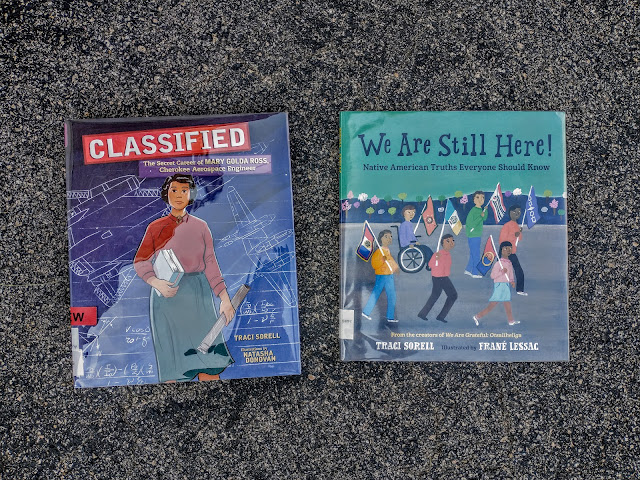
Two Recommended Native American Non-fiction Picture Books


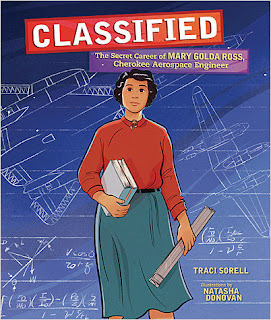
Classified: The Secret Career of Mary Golda Ross, Cherokee Aerospace Engineer by Traci Sorell, illustrated by Natasha Donovan.

This is a picture book biography of Mary Golda Ross, who grew up with a strong connection to her Cherokee tribe. As a woman in the 1920's who lived until 2008, her love of math and eventually engineering was uncommon, and she helped blaze a trail for other women and Native Americans. 

From the first page, Classified focuses in on four Cherokee values: gaining skills in all areas of life, working cooperatively with others, remaining humble when others recognize your talents, and helping ensure equal education and opportunity for all. I love how the material in the back of the book shows the syllabary, transliteration, pronunciation and English translation of each of these values. In my review here I thought of summarizing the four values, using one word each, but that doesn't really capture what the actual, translated values are. It feels more true to share the direct translation. 

Classified by Traci Sorell
Sprinkled with interesting truths about Mary Golda Ross, this biography tells us some of the work that Mary accomplished -- but much of it is still "classified." This made it a little bit difficult for me to remember the book, when I read it among a stack of contenders, and after it had been a little while between readings. What was it she did, again? There is no "one thing" that the book gives her complete credit for. However, this is the big truth -- our accomplishments are cooperative, and Mary Golda Ross apparently understood that well. Upon re-reading the book, I realized it's not the sort of picture book biography that is meant to tell you about one person so much as it is meant to teach you, through one woman's example, these four Cherokee values that she lived by. 

On my first read? Meh. On my reread? I like it a lot!

The illustrations are well done, and add to the understanding you get from the text. Simple, but not oversimplified, colorful yet still realistic, the art isn't showy, but it is solidly helpful. The backmatter of the book includes a timeline, source notes, bibliography, author's note, and the aforementioned four Cherokee values. 

This book was shortlisted for the Cybils Award in the Middle Grade Nonfiction (ages 8-12) category, and I think ages 8 and up is about right for it.  I would recommend it to kids parents and teachers who are interested in learning about other cultures and the core values that drive us! Bonus, you will also learn about women in STEM.


We Are Still Here: Native American Truths Everyone Should Know by Traci Sorell, illustrated by Frané Lessac

Another Cybils nominee in the elementary nonfiction category, We Are Still Here reminds me of a young adult graphic novel I read for the Cybils called This Place: 150 Years Retold. This Place won the Cybils award (for Young Adult Graphic Novel) back in 2019. It was so good. I can't believe I didn't review it here! But I helped to write the review of it posted here. Anyway, We Are Still Here gives readers a lot to unpack, and I was grateful for the context that I had from previously reading This Place

The premise of the picture book, We Are Still Here, is that each page is the project that a student has created to teach classmates about some aspect of indigenous people's history that still affects life today. There are twelve topics covered and they range from assimilation and allotment to language revival and sovereign resurgence. The text of We Are Still Here has very high vocabulary and a lot of information on each page, but the repeating refrain "we are still here," ties each page to the next. 

Hand-painted art sets the scene for each "presentation" and features a lot people -- presidents of the United States, children at school, and people on the street just to name a few. 

Backmatter is robust in this book, and includes more information on each of the twelve topics, a timeline from the 1870s to the 2007, a glossary, sources, an authors note. While I feel like this book packs a lot of information in, it also gives readers resources for further learning so that they can delve deeper into each of these topics. 

I really appreciate that repeating refrain which titles the book: We are still here! The more I have learned and the older I've become, the more I realize the truth of this and the obstacles that indigenous people have faced. I still have a lot to learn. When we moved to Connecticut, I enjoyed learning that "The Last of the Mohicans" -- a movie/book I've never watched/read -- was wrong. The Mohegan tribe is still here! 

I recommend this book for older elementary school kids and as a great resource to older students and adults. I have to agree with the books subtitle, it contains history that everyone should know. 

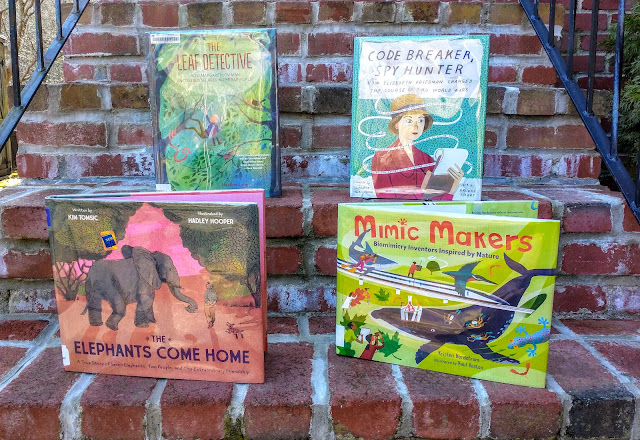
Four Fabulous New Non-fiction Picture Books


Ok friends, get your library cards ready, because today I'm telling you about more of the awesome finalists for the Cybils award that I got to read this year! They're so good!


Mimic Makers: Biomimicry Inventors Inspired by Nature by Kristen Nordstrom illustrated by Paul Boston

Mimic Makers was a big hit at my house. I think all four of my kids (ages 13, 11, 8, and 4) read all or part of it. 

I know that biomimicry is a topic discussed in first/second grade classrooms because I helped my daughter with a project about biomimicry when her school was online during the pandemic. So, when I opened this book, I hoped for some fresh examples. The shinkansen is a well-known example and I was starting to roll my eyes, but then every other example in the book was something I had NOT heard about and found absolutely fascinating.

The information is presented with a clear structure, with human interest elements, and is just so fascinating that I found myself bringing the inventions up in everyday conversations I was having. I love the way inventors from around the globe were interviewed! And, you can tell from the stories shared in the book (as well as her backmatter) that the author interviewed the inventors personally.

Meticulously researched! Fabulously written! Broad appeal! When I finished reading this book I immediately wanted to gift a copy to my daughter's teacher. (And don't tell all the other books, but I pitched this one as my personal favorite to our panel of judges.) 


I really enjoyed reading this book! Of the books on the Cybils Elementary Nonfiction shortlist this year, this was the book I was most excited to read to my family. It is a beautiful story and it did make my voice catch when I read it aloud. 

The Elephants Come Home has broad appeal. My 4 year old was very interested in it. When faced with all the nominees, a 9 year old friend of the family picked it as the most appealing cover. My kids and Jacob all read it or listened to me read it. I myself loved it. The first page gets a reaction! It seems like a love-it-or-hate-it beginning and it does hook you in. Then, the writing is crystal clear. You’re guided seamlessly through the story, which is a beautiful human and animal connection story! There’s no doubt in my mind it has both kid appeal and literary merit. 

The one thing that gives me pause is the book's treatment of race. The only time race is overtly mentioned in the book, it doesn’t put Zulu people in a positive light. Race is depicted in the illustrations, but the people of color in the book are not named. When I read it aloud to kids now, I plan to point out some of the illustrations and wonder aloud what the names of the people of color are. I think they were purposely left off to keep the story simple and the writing very crisp. The writing is crisp, but it does anonymize people of color. Despite this, I still highly recommend The Elephants Come Home.  


This book was the first of the Cybils finalists that Jubilee (age 8) read this year, and she quickly asked me if I had read it yet. "It's really good," she said. 

Code Breaker, Spy Hunter tells the story of Elizebeth Friedman, who broke SO many coded messages  and invented and taught code breaking in WWI, WWII and beyond. Her work has only recently come to light because it was kept classified for years. 

Jubilee and I both liked the page that tells about Elizebeth testifying in court and proving the opposing counsel wrong when they said she was making up the answers to the decryptions she had solved. Victory! Jubilee also liked the story of her sousing out the solution to a code that involved code words and suspicious letters about dolls. I liked the tidbits about Elizebeth's personal life and dreams - the mysterious party hosted by the Friedmans in which invitations were sent in code, and the priority that Elizebeth put on her family and home life. 

The illustrations are done in colored pencil (or colored pencil style...it's so hard to tell these days with digital art making huge strides!). The images obviously contain hidden codes that it would be super fun to try and decipher. Sadly our copy was overdue at the library all too soon! We did crack the one cypher in the back of the book that is meant to be cracked, but I have a feeling that there are many more hidden messages in the illustrations.

My book club read The Woman Who Smashed Codes, a biography of Elizebeth Friedman, last year. I didn't finish it in time for our club meeting but found it interesting and recognized a lot of the details of Friedman's life from that book. However, The Woman Who Smashed Codes has over 400 pages in which to tell her story. I think it spoiled me a little bit, because I felt like the picture book left too much out. But, that's just a personal problem. 


Multi-layered digital art made this gorgeous book stand out among the forest of options, and it was a close contender for the winning spot. 

The Leaf Detective tells the story of Meg Lowman, "Canopy Meg," as she is sometimes called. She revolutionized the way that trees are studied, invented canopy walkways, and educated countless people about trees and how and why to protect them. 

One thing I loved about this book was that aside from the main text, on a leaf on each page, new insights and facts added to the narrative. For instance, before Lowman revolutionized the field, did you know that most scientists studied tall rainforest trees by chopping them down to see what the top looked like? Or sometimes they gassed the trees so that all their leaves would fall and they could study the leaves that way. I mean, that's mind blowing! Meg sewed herself a harness and hoisted herself up into the trees to study them without killing them. You go, girl!   And her work as an inventor and educator is no less inspiring, but I'll stop ranting and let you read the book.

If I read a picture book biography, I want it to impress me with facts and research as well as story and have the answer to that all-important question that I ask myself as I pretend to be a grade school boy who could be playing video games right now, "Why should I care?" Check, check, check. The Leaf Detective was a great read. 


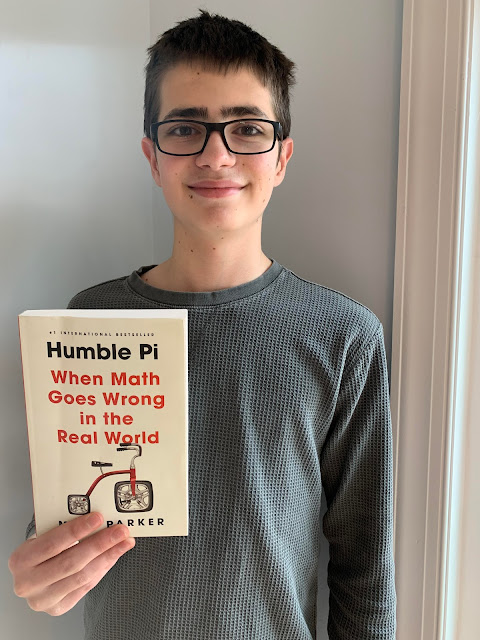
Guest Review: Humble Pi

Well hello there! Today I have a guest review for you. This review comes from Spencer, who is 14 years old. I was able to obtain Spencer's review for you because his mom, Ashley, and I are good friends. Some of you may remember that Ashley used to post on Everead regularly. Take it away, Spencer!


I have a book recommendation. It's called Humble Pi. It is my absolute favorite book by a long shot. It's about math gone wrong in the real world. It showcases many mathematical problems that have occurred over the years, covering things like coding issues, 8-bit rollover errors, bridges falling, fence-post problems (Who knew the piano was a fence-post problem?), a single book's price accidentally rocketing up to $20,000,000, and a rocket activating its self-destruct system and blowing up. Matt Parker’s writing makes these math issues accessible and hilarious. You don’t have to be a math whiz to enjoy it. It's an amazing book and cannot be ignored.  So whenever you get the chance to get it, you should read it. It's amazing. 

-Spencer Bair

Thanks, Spencer! This looks like the sort of book my family would love! For anyone else looking for a copy, I'll embed a preview and link to it below. And if you're looking for more books I recommend for teens, click here and you'll see all the posts I've made about YA fiction. This next link will take you to a post I made for some of the 13 year old readers in my life.  

Humble Pi: When Math Goes Wrong in the Real World by Matt Parker 


Cybils Winners!


I'm so excited to announce the winners of the Cybils award for Elementary & Middle Grade Nonfiction!

This year I served as a Round Two judge on the Elementary & Middle Grade Nonfiction panel for the Cybils - Children's and Young Adult Bloggers Literary Awards. The awards have been going for 16 years now, and I have been volunteering in some capacity for the last 14 years -- wow! 

I have to say that I felt like the entire shortlist for the Elementary Nonfiction category was really strong. As I told my fellow panelists, I wouldn't be sad if any of these books won. I'll be reviewing each of them in the coming weeks. The Middle Grade Nonfiction category had many strong contenders, too!

Books earn the Cybils award by being exemplary in two areas: Kid Appeal and Literary Merit. We discuss and award books on these two criteria. Do kids like the book? And is the book good, from a literary standpoint?

Round one judges read all the nominated books published in the past year (October of the year prior through October of the present year) and evaluate them on Kid Appeal and Literary Merit. They narrow this list (maybe 150 books or more) down to 5-7 titles. This is the shortlist. 

Round two judges narrow the shortlist in each category down to the single winner! And that's what we have here for you today. The BEST nonfiction book for kids ages 5-8 in the Elementary nonfiction category, and the best nonfiction book for kids ages 8-12 in the Middle Grade category.

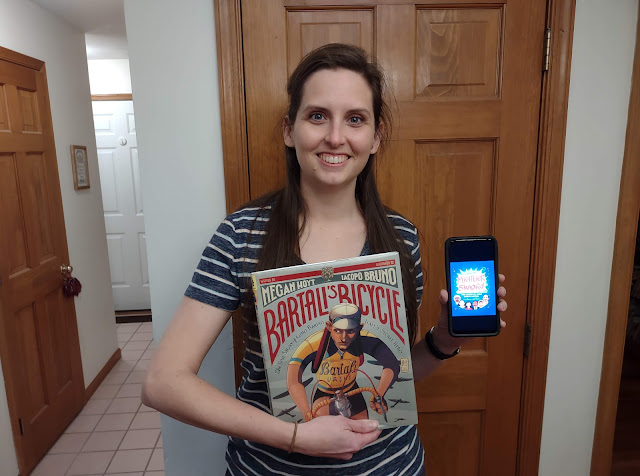
written by Megan Hoyt illustrated by Iacopo Bruno

This is a picture book biography of Gino Bartali that is so beautiful and inspiring! 

As one of my fellow panelists pointed out, riding a bike is something kids can relate to in a big way, and that's what Gino Bartali was famous for . . . at least at first. When it came to cycling, he trained persistently and eventually won the Tour de France! But when Nazis invaded Italy, Gino became another kind of hero. He used his cycling skills to protect and preserve the lives of those around him. And the humility he exhibited throughout his life and despite his achievements is memorialized here. 

In deciding between Bartali's Bicycle and some of our other strong contenders, panelists talked about the gorgeous, dynamic illustrations of Iacopo Bruno. Guys, I know "we don't talk about Bruno," but this art is top notch! Each page conveys movement and has an interesting, fresh layout. 

Materials at the end of the book include a letter to readers from Gino Bartali's granddaughter, a timeline, and a full page of sources. 

Definitely give this book a read. As soon as I finished it, I thought I had better share it with the most avid cyclist that I know. I'm sure you'll find someone to share it with, too. When looking at a picture book, you have to consider, is an adult going to want to read this over and over? Is a kid going to want to read it? Bartali's Bicycle will definitely appeal to ages 5+ and stand up to repeated reading.


 by Rochelle Melander, illustrated by Melina Ontiveros

Mightier than the Sword was a little bit tricky for some of us judges to get our hands on! It was published by a small press, and so it wasn't available in my library. However, if your library has hoopla (kind of like the Netflix of ebooks and music for libraries?), then you can find this title there. And it is absolutely worth finding!

If I'm totally honest, I wasn't particularly looking forward to reading a bunch of bios of writers. It is really easy for this type of book to become same-samey. Maybe you turn to it for one person, but you'll never read it cover to cover. WRONG! I absolutely read Mightier than the Sword from cover to cover and it was not even a chore. It was delightful! 

For one thing, the writing is engaging and fantastic. (Thank goodness! To have sub-par writing in a book about so many writers would be embarrassing.) Each person's story is brought to life with interesting details and relevant quotes. And then, if that wasn't enough, there are little sidebars or cameos of other relevant writers in each chapter. The organization of the book made it really interesting to me, as well. Each chapter is a writer's biography and they are ordered by year of the writer's birth. So, the book as a whole becomes something of a history book, as you go along. 

I'm reading A Little History of the World by E.H. Gombrich with my daughter Jubilee right now -- we're just taking a chapter at a time on nights when we can squeeze it in. It's great. But honestly, I can't wait to read Mightier than the Sword with her! She is going to eat it up. Especially because she has some aspirations to writing, and each chapter ends with writing prompts and suggestions. 

Another engaging facet of the book is the illustrations. Each writer and each sidebar gets a portrait by Melina Ontiveros. For the names I didn't already recognize, it was fun to try to puzzle out who this person would be based on the small items included in their portrait. 

As a group, we round two judges loved that it was a diverse group of writers highlighted. Not only were writers from a variety of homelands and races, but also diverse through time, as I've mentioned, and they are diversely famous -- some of them are famous for being writers (Shakespeare is profiled), but others are more famous for other work they've done (Florence Nightingale, for instance). And still others of them weren't already known to me. Mightier than the Sword made learning a pleasure. 

One of my fellow panelists was formerly a teacher and she was very excited about the potential for classrooms to use this book. It would be very easy to read excerpts, and of course the suggested writing activities would connect to teachers and students well, too. 

I hope winning the Cybils award for Middle Grade Nonfiction shines some more light on this book, because it deserves to be found! 

A full list of this year's Cybils winners in all categories can be found here

Alysa's Summer Reading

Hello! I did do some good reading this summer that I want to share with you. 

Race the Sands by Sarah Beth Durst 

My book club read this fantasy novel and it was enjoyed by all. A couple of us thought we were reading a YA fantasy book, but it turns out this one is marketed to adults. The main premise is that in Bekar, people live good lives hoping for rebirth as a human or auger. The worst thing to be reborn as is a kehok - a monster. The kehoks are dangerous, but that doesn't stop people from racing them! We follow a trainer, a rider, and the political turmoil in the country. 

Our group agreed that the worldbuilding and characters were excellent. It was so refreshing not to have a love triangle! And the abundance of strong female characters was awesome. There was a fair bit of violence in the book, but prrrrobably definitely less than The Hunger Games or something. No bedroom scenes. I was so into the book that I ended up telling my kids all the plot of it, just because my mind was so thoroughly engrossed. I definitely filtered out some of the violence in my retelling though, ha! Recommended. 

The Code of the Woosters by P.G. Wodehouse

This was my pick for book club this summer. It met with mixed reviews in the club, partly because it came on the heels of Race the Sands, and Bertie Wooster is very down on Angela Basset throughout! Those who liked it really liked it, and those who didn't, didn't. I find that's pretty typical of humor books. 

The Code of the Woosters is a middle book in the Jeeves and Wooster series. It was the most accessible title at the local libraries, which is why I chose it over Right Ho, Jeeves, which is probably my favorite (Right Ho, Jeeves is especially good on audio). Anyway, the series follows young bachelor Bertie Wooster in London in the 1930's, who is constantly getting into tight spots and requiring the ingenious brain of his valet, Jeeves, to get him out of trouble. This installment details Bertie's misadventures with a collectible silver cow creamer, blackmail, rifts between lovers that could have dire consequences for him, and more. I noticed it was on a list of recommended classics for eighth graders, and I could get behind that. If you want to dip your toes into the Jeeves and Bertie world, you can always look up some of the old episodes of the BBC TV adaptation on YouTube for a taste. 


How Not to Die by Michael Greger, M.D., FACLM

This thick volume details the research on nutrition in health for a number of scenarios. There are two main sections in the book: the first section has chapters organized by disease, the second section has chapters organized by types of foods. Chapters in section one include How Not to Die from Suicidal Depression, How Not to Die from Breast Cancer, How Not to Die from Diabetes and many more. Chapters in section two include Spices, Cruciferous Vegetables, Berries and many more. 

I became interested in reading this book because I did an internet search for "how to lower your estrogen" and the search results I found referenced the book multiple times. Obviously, I thought, it would be a better source of complete information. And I was right, there really is so much info in the book. The author has made a living of studying medical research findings and publishing them in layman's terms. He runs the website nutritionfacts.org. His grandmother's life was saved when she changed her diet in her old age, and he shares that amazing story in the beginning of the book. 

I didn't read the book cover-to-cover, but I did read large swaths of it, and found it fascinating and motivating. I shared enough passages of it with Benjamin that he took it up himself and started sharing passages back with me. We've both been eating healthier since. I recommend it, if you're interested! 

Oh, I also checked out the How Not to Die Cookbook from my library. It was alright. I've learned how to make vegetable broth now. I took down a few of recipes before I returned it: the one for Veggie broth, one for a dish of beans, rice and broccoli, and the last for a dairy-free "macaroni and cheese" dish.  My favorite healthy eating cookbook is still The Smoothie Project by Catherine McCord.


The No. 1 Ladies Detective Agency by Alexander McCall Smith

This was the August pick for book club, and I had read it for another book club in another state some years ago. I remembered liking it, and I remembered all of the worst and most violent parts. So, I'm happy to say that I really enjoyed the reread!

This is the first in a series of detective novels set in Botswana. The author helps us get to know our lady detective, Mma Ramotswe, explores her country and family history, and takes us on several of her cases. 

Some of the cases are lighthearted and some are heavier, and the book strikes a good balance. I definitely categorize it as "for grownups," but then again as a teen I read a lot of Agatha Christie. Anyway, since I had read the book before and many of the cases outcomes came back to mind as I was reading, I was able to really enjoy the superb writing in this book and appreciate some of the humor and foreshadowing that I couldn't enjoy last time, because I was on the edge of my seat, metaphorically. I might read more in the series . . .There are apparently 21 books in the series now, wow. 

This is another series (like Jeeves and Wooster, above) that has been made into a television show. After reading the book I did look up the first episode of the show on YouTube, just to satisfy myself that I was pronouncing Mma correctly (and to pass the time as I folded laundry). Unfortunately I can't recommend the series, because it makes the main characters into buffoons. I was offended, on behalf of Mma Ramotswe. (Incidentally, Bertie Wooster is also a buffoon, but he is meant to be a buffoon.)

How We're Doing Flexible Preschool at Home This Year

Fall of 2020 is when I would have enrolled Sam in a preschool, but because of the ongoing Covid-19 pandemic, this year we are doing preschool from home. Because the older kids (in grades 2, 5 & 7) are also doing school from home, my home preschool time has to be very flexible. 


Here's what Sam and I do together:

  1. Read books - Sam loves to read, and we have tons of books. I usually tell him to pick a few for me to read aloud during "Book time."
  2. Play Games & Do Puzzles - At a younger age than any of my other kids, Sam loves games and puzzles! One of our new favorite things is this build a skyscraper set. 
  3. Play with Toys - Our favorites on rotation right now are Lego duplo, Magnet tiles, and Blocks.  
  4. Paint/Craft/Playdough - I'm using the Little Hands Art Book to help me plan some crafts. We don't craft every day, but we have fun when we do it. 
  5. Clean up - I am the absolute worst at making myself and my kids clean up. Having someone else teach my kid about clean up time is definitely something I like about preschool. Now I'm bootstrapping it and attempting to teach Sam to clean up myself!
  6. Watch a Show - Daniel Tiger, Magic School Bus, and Mickey Mouse Clubhouse are Sam's favorites. 
  7. Starfall - With his siblings doing so much of their learning on computers, and Sam soaking in that example, he is dying to get on the computer himself. Starfall.com is an online learning platform that offers some of their content for free. (Back in 2007 when I first heard of it, it was all free. Different times.) Sam enjoys it, and it is simple and ad free. I let him have about 10 min/day. 
  8. Outside Time - Right now with winter in full swing, this is mostly either checking on the chickens or sledding. 

Real talk: I spent a lot of time this fall teaching Sam not to be on camera during his siblings classes. And while I have meant to do music time with Sam as part of preschool this year, I can't honestly say that I have, yet. There was one time, but it's definitely not even part of our very flexible setup. However I did start giving his sister piano lessons a couple of weeks ago, and he often scootches in on those.  

Just recently I wrote down a schedule for Sam. I'm sure we will make some edits and improvements to it, but here's what it looks like right now:


We are really enjoying it, and refer back to it when we need some structure. When we don't need structure, I just don't bring it up. Ha! 

Here are some of the resources I'm using:

Books for Me

Practical Wisdom For Parents by Nancy Schulman and Ellen Birnbaum - This book is a great reference to have handy as I'm trying to figure out preschool at home. It discusses in depth what a good preschool should have, and also what parents should do at home to support their kids. Rereading part of this is what prompted me to write down a schedule for Sam . . . I had been meaning to do it, but the authors made a great case for it, which spurred me to action. My full review of the book is here

The Little Hands Art Book by Judy Press - I'm just taking projects from this willy-nilly and picking the ones I feel like doing. We don't use this book every day, or even regularly on a certain day of the week, but I have enjoyed the crafts that we've done from it, and some of the older kids have gotten into them, too. 

Books for Sam

I wrote a whole post about the books Sam is loving recently! Add Good Guys 5 Minute Stories to that list, because it is a big hit right now. It is a compilation of a bunch of full length picture books, back to back. 

Games


Build a Skyscraper - I don't know if this set of sturdy cards is more game, puzzle, or toy, but it has elements of all three and we are enjoying it. I received it for review and we have spent a fair bit of time improving Sam's fine motor skills and just building cool towers. Sam especially likes the clock card, which makes your building look like it has a giant clock on the side, and the door cards. I like that it can be put away very small, but yet build towers that are impressively big. 

Count Your Chickens - This is a super simple cooperative game we have enjoyed together. You spin the spinner, and count how many squares you have to go to get to the picture you spun. Then, you put that same number of chicks into the coop. If you spin the fox, watch out! You have to remove one chick and put it back in the yard. If you get all the chicks in the coop by the end, you win!

We've also been enjoying classics like Memory and Hi Ho! Cherry-O

I figure playing games together is a good way to teach turn taking and rules, in the absence of a preschool environment. 

On Flexibility:

It's my tendency to be too flexible, rather than too rigid, about a schedule. So, writing down the schedule has really helped me, and Sam, too. The advantage of not putting times on the schedule is that I don't feel "behind" if something comes up. For instance, on Tuesday morning I had to run some errands. Because our schedule isn't attached to times of the day, Sam could just hang out with Dad while he worked. When I came home again, Sam was still in his pajamas and I didn't feel like I was off the schedule. 

Some days we don't do everything on the schedule, but most days we do. And some days we don't do it all in order, especially lunch. Lunch happens by the clock and the signals we get from our stomachs, so the rest of it shifts around to make sure lunch happens on time. 

I do try to get the kid dressed. As the old saying goes, pick your battles. I choose the parts of a routine that are the most important to me and let others move or be skipped to preserve peace of mind.   


Four Book Club Books I Enjoyed Recently


The book group I'm in didn't meet from March - August 2020, but we did start meeting again in the fall. For September and October we met outdoors, but for November and January we met online only. Here's what we've been reading.

Gilead by Marilynne Robinson

I really liked this book. It started off as a family history reminiscence, but wound its way around into being a present day drama, connected of course to the family history. I liked that it was short and succinct. I liked that little tidbits were revealed. I loved little lines like "[Television] seems so two-dimensional after radio." And I loved the parallelisms for instance, the young Jack Boughton being mistaken for a preacher. The time that Lila comforted John Ames "you'll be just fine" and the time she comforted Jack "People can change." I liked how the book shifted from quoting the Old Testament to quoting more of the New Testament, reflecting changes in the spiritual life of the family. 

The book is a letter, or book of remembrance, that John Ames writes for his young son. John is in his seventies, and tells of his life growing up and marrying his childhood sweetheart, only to lose his wife and baby at the baby's birth. In a roundabout way he imparts the lessons of his widower life and the love story that surprised him late in life. Throughout the book John switches from remembering the past -- sometimes remembering stories of times before he was even born -- into the present moment. This switching and the little sections the book is written in work very well to convince the reader that the book was written over the course of a few months, here and there.

Touching moments and astute reflections abound in the book. Our book group discussed many of these! I was surprised by how many people had come with passages marked that they loved and wanted to talk about. 

The Silent Patient by Alex Michaelides

This one is a murder mystery (chosen for the month of October). I listened to it on audio, and the swearing bothered me a bit. There was plenty of sex, drugs and violence, too! The suspense was very well done though, and the plot was twisty and had lots of red herrings. It was a nail biter, right up until the big reveal.

The Silent Patient is narrated by a psychologist whose patient never speaks. She is a famous artist, institutionalized after being convicted of the murder of her husband. Did she really murder him? If so, why? If not, who did? 

The interplay between Greek and Christian names and symbols in this book was one of my favorite parts of it. 

We had a great time discussing all of our hairbrained theories about who had done the murder. I found it interesting that the two group members who read the book quickly both suspected the same person, while those of us who read the book over a longer time had various other theories. 


When Breath Becomes Air by Paul Kalanithi

I had heard of this book, but it wasn't until it was selected for book club that I realized its settings were closely tied to the settings of my own life. Paul Kalanithi, who wrote this memoir as a young doctor dying of cancer, moved to Kingman, Arizona when he was ten years old. About ten years later, I moved to Kingman, Arizona when I was nine years old. Eventually Paul moves to Connecticut to study at Yale. I currently live in Connecticut, about an hour from Yale. I really enjoyed connecting with the settings of Paul's life so strongly. 

I expected this book to be more about dying than it was. I expected it to be like The Last Lecture by Randy Pausch, which I had read previously and enjoyed. When Breath Becomes Air is much more a descriptive memoir and less a prescriptive, well, lecture than The Last Lecture. I felt like I got to know Paul a little bit, and that was meaningful to me, knowing that we have some mutual friends. 

This was another book the people marked passages from and shared insights about. Discussing hypothetical situations about death, current medical situations and problems, and tender family moments was the meat of our book club conversation.   


The Good Earth by Pearl S. Buck

I listened to this one on audio, and the narration was excellent. I had never heard of The Good Earth before it was picked for book club, but Jacob had. 

The Good Earth reminded me of The Fiddler on the Roof -- it's a life story. The Good Earth follows Wang Lung from the  morning of his wedding day until his death. There's a lot that happens in between! I feel that I learned about Chinese culture in the late 19th and early 20th century, along with learning about these particular characters. 

I was reminded of Boxers & Saints, a pair of graphic novels that I love, since the books are set in the same time period. 

Our book group talked about Chinese culture, what we loved and hated about Wang Lung's choices, the strength of O-lan, the way nature grounds us, and more. 

For next month's book group I get to pick the book. I've chosen All Thirteen. It's really SO good. It's winning all the awards right now. My review here

Books for a New Chicken Keeper

My mom has been telling me for years now that I ought to get chickens, and I would love it. Well, I think she was right. We've had our chickens for 6 days now, and I am loving it. 

The day we got the chickens, it snowed!

I was talking on the phone with mom just before Christmas and she said, "Is this the year that I get to buy you a chicken coop?" I said that this year it was actually fathomable that we could keep chickens. We are now living in our own home and my youngest is 3 year old. Well, she and my dad bought us the Omlet Eglu Go. It's a chicken coop to house 2-4 hens (up to 6 if they are bantams). 

Along with the coop she sent a book, How to Speak Chicken by Melissa Caughey. This was a good move! Reading this book got me more excited than I ever had been to own chickens. The author loves her chickens dearly and just makes the chicken keeping life seem enjoyable and accessible. 


After reading How to Speak Chicken, I started researching chicken breeds in earnest. I had each of my four kids pick out a breed of chicken they'd like. I figured since the coop can hold four chickens and I have four kids, everybody can have their own, right? Sam didn't care, yet. 

We planned to order chicks online, once we figured out that if we ordered from Meyer in the spring then the a minimum order requirement was much smaller, but then we encountered the cost of shipping. I think it was going to be about $50 to ship 4 chicks (who cost about $3 each).  That was just too much for Jacob. So we hung on for a little bit, hoping to find some chicks locally this spring. 

However, I had posted on our local chicken keepers facebook page, asking for recommendations on where to get chicks, and someone wanted to get rid of chickens and remembered my post. She sent me a message last week asking if we still wanted chickens and offering hers to us for free. After doing all the hard work of raising this chicks into hens of about 7 months old, she was finding the chicken keeping life too stressful. Her preschooler was terrified of the chickens, and her neighbors 4 pitbulls didn't like them either. They weren't laying yet, despite being old enough. 

Well! Although my kids had their breeds picked out, this worked out great for us. Jubilee had hoped for a chicken just like this (an Isa Brown, or Cinnamon Queen, or anything that will lay lots of eggs and be nice). And Sam doesn't care. So we adopted/rescued two chickens, about 2 hours later. We don't know exactly what breed they are, they were purchased from a bin that said "brown egg layers."

This is Sprite


This is Rootbeer


Now, on the Facebook group I also got a recommendation from someone to find Storey's Guide to Raising Chickens -- so I put that on hold at the library. I was glad I had it checked out when we got the chickens one unexpected Tuesday! It has come in handy as I have had questions about feed, winterizing, and housing chickens (can we fit a few more in this coop? I think we can, but we might want to extend the run, according to Storey's Guide). 

Storey's Guide to Raising Chickens

The only complaint I have about Storey's Guide is that it's aimed at people who want to have more than 2 chickens right now. I mean, I get that. I think it's much more common to have more than two, and we do plan to have four at some point. Four is both the maximum for our coop and the maximum for our property size, according to our town. 

I have also found good info online about keeping chickens. I haven't got favorite websites yet, but I'll let you know when I notice myself revisiting certain sites. 

It sure was a thrill when we got our first egg! I wasn't sure they would lay until things got warmer -- we've had a bad cold snap this past week (and snow and wind, today), and I thought maybe they wouldn't lay until they were getting more light. But I was delighted to discover an egg in the coop on Friday morning, Saturday afternoon, and one on Monday morning before the chickens had breakfast. Was it laid on Sunday? We'll never know. 

Spot the egg...

Today we had a more stressful chicken adventure. With the recent cold, plus today's snow and wind, I was keeping a close eye on the chickens. I looked up what to watch for and this afternoon, as the first signs of frostbite showed up on Rootbeer's comb, I decided to move the chickens and their coop into our attached garage. The sudden move and the completely alien landscape stressed the chickens out a bit, I think. Them being stressed made me a little stressed. I hope I moved them soon enough to prevent permanent damage to the birds! Nothing was turning black yet, so I'm hopeful. 

I'll keep you posted. 

p.s. The other book that made me want to keep chickens was Some Writer, which I read back in 2018. 

Read Anything Good Lately? Seven Guest Reviews

I've been thinking for a while that I ought to have some of my bookish friends over onto my book blog. So I emailed 7 women whose taste in books is a great match with mine.  I asked them to recommend a book they've loved, a book that everyone should read, or a book to which they want to give a signal boost. Well these books have just jumped to the top of my list! 

Welcome to my
Guest Review Party!


We've been listening to the audiobooks of the Michael Vey series, by Richard Paul Evans. They are SO much fun! Michael Vey is a teenager who secretly has the power to manipulate electricity. He thinks he's alone in this gift, until one fateful night, his mother is kidnapped, and he discovers that he's one of 17 electric children, born within the same week at a hospital with an experimental machine that went haywire and imbued a number of newborn babies with varying electrical talents. Now he has to find his mother, rescue her from the bad guys who are trying to use the electric children to take over the world, and maybe rescue some of the other electric teens along the way. It has action, adventure, humor, and suspense, and we have loved taking it on road trips or just listening together while we make dinner or do the dishes at night. The series is already complete with 7 books, so no need to wait for new installments. Two thumbs up! -- Ashley my erstwhile coblogger


The book that stands out for me this year is Crownchasers, the first in a series by Kansas author Rebecca Coffindaffer. It's a great Science Fiction adventure with an absolutely smashing heroine in Alyssa Farshot, the captain of a worldship and the niece of the emperor. When her uncle suddenly dies, Alyssa is dragged into a race across space against some of her closest friends to become the next emperor. Except the race isn't as fair as everyone thinks. The worlds and peoples that Coffindaffer dreamed up are incredible, but beyond that: this book was a non-stop adventure I couldn't put down. I can't wait to read the next installment! -- Melissa Fox of The Book Nut


I would love to shine a light on Emily Arrow's Studio: A Place for Art to Start. I love whenever I find a book that doesn't follow the typical pattern of solving a problem or extending a familiar series. Studio is a sweet read-aloud poem that celebrates creativity and collaboration in a way that feels fresh and even quietly subversive. The text and illustrations invite readers to think about creativity beyond arts and crafts, and I'm sure it's inspiring readers of all ages to go make something quirky, weird, and totally original. -- Heidi Fiedler at https://www.helloheidifiedler.com/


The book that stands out for me lately is City Spies, by James Ponti. It’s the first of a new middle grade series about a group of five kids from around the world who are recruited to be spies. It’s a perfect combination of humor and action. I was reading it with my daughter nearby, and she asked why I kept laughing aloud. Always a good sign! City Spies inspired me to go read Ponti’s Framed trilogy, which I devoured over the next week or so. I’m eagerly awaiting the second City Spies book, due out in March. -- Jen of Jen Robinson's Book Page


Accidental Archaeologists: True Stories of Unexpected Discoveries, by Sarah Albee, is a great book to offer the 10-12 year old who has an interest in archaeology--the sort of kid that went through an Egyptology phase as an 8 year old--, or indeed to anyone, young or old, who enjoys learning new and different things about history told in a friendly, easy style!

The book is self-described as a collection of "chance discoveries by ordinary people" that contributed to our understanding of the past. Arranged in chronological order of the discoveries (which has the added bonus of seeing how archaeology has changed over time), these chance finds from around the world are indeed extraordinary, marvelous, discoveries. Included are some that will be familiar to many kids in the US, like Pompeii and Herculaneum, and some that will quite possibly be new, like an Aztec temple in Mexico City, and a South African cave full of the fossils of a previously unknown early human species. They really are all tremendously exciting finds from around the world!

Albee does a truly great job providing historical context for many of the finds (along the way, for instance, you'll learn lots about the history of Thailand, and slavery in New York), and in some cases, the discoverers are brought to life too--like the black cowboy who found the first huge bison kill site in the US--which adds human interest. Lots of vintage illustrations, maps, and sidebars give even more substance to the already rich descriptions of each discovery. The accessible, almost conversational style of the stories allows Albee to include past injustices, misconceptions, and mistakes in a way that's thought provoking without being preachy.

In short, reading books like this is a great way to learn, and there's lots to learn here, not dumbed down at all, and so much more fun than reading books written for grown-ups! As a professional archaeologist myself, I'm happy to be able to endore this book wholeheartedly!-- Charlotte at Charlotte's Library


I came across one of the strangest books I've ever encountered the other day, and I truly don't know what to think about it so I'm hoping that writing about it will help me wrap my mind around it...you should check it out. Victor by Jacques Maes and Lise Braekers.

Victor has achieved his life's goal of shooting a cheetah and he proudly displays the skin in his home. But after a night of restless sleep during which he dreams of the cheetah's mourning friends, a remorseful Victor decides to make things right with the cheetahs by creating his new life goal: protect the murdered cheetah's coalition from the same fate. Victor sews himself into the cheetah skin and befriends the cheetah's old friends, who think their friend has returned, and he feels a sense of love and family for the first time in his life. However, the coalition eventually comes to realize they've been deceived and decide to give him a taste of his own medicine at that moment Victor awakes from what has been a dream all along.

Most of the story's emotional and tonal progression lies in Braekers' illustrations, and readers are encouraged to seek out every last detail to capture the story in its entirety -- in fact, much like a hunter taking its prey by surprise, the visual story begins even before the title page, where we see Victor shoot the cheetah on the front endpaper. Created in mostly yellows and greens, Braekers' images heavily rely on the contrasts in shape, size, and shadow to carry the emotional weight of the story. The text is fairly minimal, but Maes' words are poignant and resonant.

Haunting? Yes. Horrifying? Definitely. But valuable in its unbridled efforts to generate a lasting sense of empathy.

 -- Mel at Let's Talk Picture Books


You already know Dav Pilkey, author of Dog Man. I am always looking for books that straddle the Pilkey line; i.e. they are equally amusing to elementary students and middle school ones, and I find them engaging as well!

An excellent example of this is Julie Falatko’s Two Dogs in a Trench Coat series. These are definitely goofy. We get to see dogs Sassy and Waldo navigate their boy Stewart’s world and showcase their obsession with food. Since they are bored at home, they plan an elaborate ruse. With the aid of a trench coat, they convincingly present themselves as a new student, Salty, from Liver, Ohio. They are interested in school primarily because of the lunches, but get into many school hijinks. Through it all, their classmates and teacher are, of course, completely oblivious to the fact that Salty is really two canines.

Hysterically funny writing aside, the Colin Jack illustrations are humorous and endearing as well. Stewart loves his dogs and wants the best for them, and if it involves bringing them to school so they are not lonely at home, he is willing to do that. The plots are all vaguely reminiscent of ones where students move to new schools and struggle to make friends, making this a very clever twist on an established middle grade trope.

What I liked best about this series, which makes me a little sad now, is that Falatko seemed to understand my dog Sylvie’s very soul. The attitude that Waldo and Sassy have towards squirrels, their constant attention to all available food, and their phrasing all harken to the “conversations” that my dog had with my daughters before she passed away. “Tiny carrots wrapped in bacon!” has become a family catch phrase for good eats! Given that I was the primary voicer of Sylvie's thoughts, perhaps Falatko understands MY very soul.

Two Dogs in a Trench Coat has numerous slapstick moments, many visual jokes, and plenty of goofy humor, but at its heart, the series is a highly philosophical discussion of the bond between dogs and their human, and the deep contentment that dogs find in moments of domestication. Waldo voices this perfectly in this interchange:

"If wild dogs knew how dry and warm it was inside, they'd stay in when it's raining, too. But okay. We are wild dogs on the inside."

"Inside of the house," said Sassy.

--Karen at Ms. Yingling Reads

*********

It has been so fun putting this post together. It brought back memories! I thought of eating lunches together at KidLitCon. I smiled about long email threads exchanged with these friends about Cybils books. I felt like I got a peek at the bookshelf, in this time when I haven't seen anyone else's bookshelves in ages! 

The thing I miss most about pre-Covid life right now is the "incidental learning" that happens naturally when people get together. I miss noticing that a friend has a book sticking out of her purse and asking her about it. I miss watching my friends in their kitchens and going home with new ideas on how to cook and clean. I can see the light at the end of this tunnel, and I'm thankful for some of the brilliant moments within the tunnel as well.

Happy Reading! 

Related Posts Plugin for WordPress, Blogger...