Quantcast

Alysa's Summer Reading 2025

 I read some good books this summer that I don't want to forget about! Here they are in no particular order:


The Five Worlds Series
- Graphic Novels by Mark Siegel & Alexis Siegel, illustrated by Xanthe Bouma, Matt Rockefeller and Boya Sun. 

Jubilee discovered these at the library some years ago and loved them, and bought each one as it came out. This spring, Sam enjoyed them all and he finally convinced me to read them over the summer. I have no regrets -- they're a solid contribution to the fantasy graphic novel for ages 8+. The Five Worlds are out of balance and some say that lighting the beacons will save them, but others think the beacons will destroy more than they save. The books have some beautiful art and some memorable intrigue and characters. Recommended.


Braving the Wilderness: The Quest for True Belonging and the Courage to Stand Alone
 by BrenĂ© Brown 

I have enjoyed some talks and videos by the author, so I opted for the audiobook, and listened to this one. I really enjoyed it. It centers around belonging, especially in a modern, polarized world. It talks about elements needed for belonging, and for those moments when we realize we don't want to belong but to "brave the wilderness" instead. The stories in the book were captivating, and the research-backed conclusions and advice in it ring true. 


The Talisman Ring by Georgette Heyer

My book club friends asked me to pick a "beach read" and this was my pick. Not exactly beachy in any way, really, The Talisman Ring is both a light-hearted murder mystery and a comedic romance. On the Old English coast, local baron Sylvester dies and on his deathbed he insists on the betrothal of his nephew Sir Tristram and to his granddaughter Eustacie. Unfortunately they are a terrible match for each other. Eustacie runs away at midnight and meets her true love, who is wanted for murder. The rest is a series of madcap adventures and humorous scenes which all come together happily in the end. 


Mickey 7 by Edward Ashton

Ben checked this one out from the library and I read it, too. It was an enjoyable sci-fi story about an expendable man. Mickey signed up to go on a dangerous planet-colonizing mission and to be the one who would upload his brain regularly and do all the jobs likely to end in death, knowing that his clone would come out of the machine if anything happened to him. I particularly liked the characters in this book, who were a lot of fun and drove the plot well. I wasn't surprised to learn that the book has been made into a movie, but I'll stick with the book, because descriptions of Mickey's deaths weren't too gory, and I think the movie would be worse for me, in that sense. There was a bedroom scene, and if I remember right a little bit of language that I could have done without, but overall it was a fun book, and I loved the ending. 


The Demon in the Freezer: A True Story by Richard Preston

Ashley Z picked this one for book club and it was an enthralling, unpleasant read. We agreed as a club that we loved it but were totally grossed out. It talks a lot about anthrax, and the anthrax scare of 2001, which was pending investigation at the time this book was published. It also goes into depth about smallpox -- its symptoms, eradication, and status today. It was very interesting, but I did have to skip ahead in the audio once or twice when descriptions became too gruesome for me. Nevertheless, I feel better educated for having read it. It was also super interesting to read it from a post-covid point of view, since global pandemic is a big point of speculation in the book. 


Tools for Teaching by Fred Jones

I checked this one out of the library because the library didn't have The First Days of School by Harry Wong. No regrets, though! This book had a lot of interesting and helpful tips for middle and high school teachers. I'm still mulling over the advice on classroom furniture placement, step-by-step guidance, and motivational learning games. It seemed like an oldy but a goody, and I read the whole thing. I did also find and skim through a copy of The First Days, as well.  


Jubilee's Summer Reading 2025

 Jubilee Summer Reading 2025

This summer, Jubilee kept a Summer Reading Log for the library's summer reading program. I thought it would be fun to preserve it here, along with her comment at the end, once she discovered the log was optional.

For the record, this was the summer before she started 7th grade, when she was about twelve years old. 


River Secrets by Shannon Hale
The Big Bad Fox by Benjamin Renner
Wayside School books 3&4 by Louis Sachar
Dreamslinger by Graci Kim
The Penderwicks books 1-4 by Jeanne Birdsall
Squirrel Girl books 1&2 by Shannon and Dean Hale
Crogan's Vengeance by Chris Schweizer, James Lucas Jones, and Jill Beaton
Another Castle; Grimoire-Andrew Wheeler and Paulina Ganucheau
The Unbeatable Squirrel Girl Beats up the Marvel Universe by Ryan North
Morrigan Crow books 1-3 by Jessica Townsend
Dragon Fury by Lisa McMann (last book in a sequel series)
Tress of the Emerald Sea by Brandon Sanderson
No Talking by Andrew Clements
Alcatraz vs. the Evil Librarians books 1-6 by Brandon Sanderson
Sorcery and Cecelia or The Enchanted Chocolate Pot and sequel by Patricia Wrede and Caroline Stevermer
Jedi Academy books 1&2 by Jeffrey Brown
Spoken Mage books 1-4 and accompanying novel by Melanie Cellier
Amulet books 1-9 by Kazu Kibuishi
Skyward, Starsight, and Cytonic by Brandon Sanderson I think I read the other books, but by then we had turned the summer reading thing in and I realized I DIDN'T HAVE TO DO THIS THE WHOLE TIME >:( ! 

Jubilee Reviews Ranger's Apprentice by John Flanagan


     The Ranger's Apprentice is a 249-page novel about an orphan named Wil. Wil was discovered on the doorstep of Castle Redmont, Fief Redmont's castle. The Baron Arald takes him in, as well as all the other orphans in his Fief, out of the kindness of his heart. The story begins the night before Choosing Day, the day when all of Redmont's orphans who are turning fifteen choose their profession at the castle, with the agreement of the leaders of those professions at the castle. Tragically, when the day comes, all of Wil's friends are picked, but nobody wants him. Wil is destined for a life at the farms, but the mysterious Ranger Halt passes an odd note to Baron Arald. Wil is curious, and the next night, he is determined to discover the contents of that note.

    Ranger's Apprentice is a heartwarming tale of loyalty and friendship, a book halfway between realistic fiction and fantasy. The beginning half details a tale of day-to-day work and a fierce rivalry. The second half features a dashing adventure with ups and downs, chock full of medieval fun. This is a great book for fans of realistic fiction (think My Side of the Mountain) and fantasy (think books by Brandon Mull). The Ranger's Apprentice is an amazing middle-grade novel and will leave you thirsty for more. Luckily, there's a whole series, then sequel series to Ranger's Apprentice, and The Brotherband is in the same world, too. I deeply encourage you to read the amazing Ranger's Apprentice.

    I personally have read all of the Ranger's Apprentice books, and have even bought the ones that the library didn't have. Again, so gripping! I would recommend this book to 11-year olds to 13 or 14-year olds. I am 11 and grasp pretty much all of it, but I think it would be a fun read for young teenagers, also. The Ranger's Apprentice is one of my personal favorites, and I think it could become one of yours, too!

The first book in a great series!

Levi's Review of My Side of The Mountain

My Side of The Mountain

Reviewed by Levi Stewart, Author Jean Craighead George

My Side of The Mountain is a book about a boy named Sam Gribley who runs away from his city life to make a home in the wild. He builds a home in a tree and learns to find food, and even tames a falcon. There's more to the story, but I won't spoil it for you. I really like this story. I have always dreamed of doing the things Sam does, but I would never be able to leave the comforts of my home permanently. My Side of The Mountain is a great book that you can read over and over again (I know I have!).

The book is about 175 pages long, but has pretty small text. I would recommend  it for everyone, but especially ages 9-12. It will take some knowledge to understand what it's talking about, and there are some diagrams in cursive, but it's not difficult to grasp the general concept. I first read it when I was about 8, and have read it lots of times since. I just read it this summer. Overall, I really love this book. 10/10. I would love to read more books like this!
 

Jubilee's Review of Secret Coders


Secret Coders series

 Reviewed by Jubilee Stewart, Authors Gene Luen Yang and Mike Holmes

The series Secret Coders is an awesome story about three main characters, Hopper, Eni, and Josh. When Hopper moves to Stately Academy, she notices things. Why are there so many nines around the school? What's hiding in the janitor's padlocked shed? What's up with the birds? As she struggles to figure out these mysteries, Hopper learns to code, and we learn along, too. Repeats, parameters, Ifelse (If-fell-see) statements, and much more. Hopper, Eni, and Josh's struggle creates a beautiful story of friendship, courage, and laughter. As you get to know them, you'll agree; they make great secret coders.

The series is made up of 6 graphic novels which each have about 100 pages. I would recommend these books for ages 7/8-11. Though the books are small, it takes a bit of knowledge to understand the code. There are small puzzles throughout the book in the form of solving code. I thought that they were fun. Five out of five stars. If these authors ever paired up again, I would definitely be in line for their book! 


Unbroken (The Young Adult Adaptation): An Olympian's Journey from Airman to Castaway to Captive

Unbroken (The Young Adult Adaptation): An Olympian's Journey from Airman to Castaway to Captive
by Laura Hillenbrand

One of the reading goals I've made this year is to read the books that my son is reading in his high school English class. So, that's what gave me the guts to finally pick up Unbroken

Unbroken is a biography of Louis Zamperini who as a kid was a trouble maker, as a young adult was an Olympic runner and who then enlisted and fought in World War II where he was lost at sea and became a prisoner of war. His life is truly amazing and inspiring to read about, and it's no wonder this book was chosen for the Honors English unit on survival. He survived not only these things, but post-war difficulties as well. 

The original edition of the book is subtitled "A story of survival, resilience, and redemption." An apt description! 

I first heard about Unbroken when my book club read it ten or eleven years ago. For one reason or another I couldn't read the book at the time, but I attended the discussion. It sounded like an amazing story, but maybe a bit too graphic or disturbing for me -- some of my book club friends had said it was very detailed about the violence that Zamperini experienced as a prisoner of war, and shared some of the truly disturbing cruelty he faced, so I was hesitant to read the book, despite their reassurances that it was worth it.

I was glad to see that the class was reading the young adult adaptation of the book. I looked up what the differences were between the original edition and the young adult edition, and the version I read was shorter, had fewer detailed descriptions of violence and fewer details about Zamperini's alcoholism after the war. Perfect for me. 

I had just read Life of Pi, so reading the story of Louis Zamperini being lost at sea was particularly heartwrenching and fascinating. How I wished that he had known sharks are edible! My heart is still a little bit crushed over that detail of his ordeal. After reading Unbroken, I read Mrs. Frisby and the Rats of NIMH and saw some striking parallels, but that's a post for another day.

I'm happy to recommend this book for teens and adults. It has just about everything you could want from a biography. It has moments of daring, moments of heartbreak, tender moments, funny moments and miracles. It is beautifully written and meticulously researched, never drags along when giving context but somehow perfectly tells the story in a way that incorporates all the surrounding details you need to know. I'd like to own a copy of myself. I've lost track of how many small moments from the book I have told to friends and family members. It has been a little while since I finished it, and it continues to be on my mind. 

Just yesterday I read the famous poem Invictus by William Ernest Henley and thought, "That's Louis Zamperini." A friend mentioned that her son is doing some troublemaking, and I thought, "There's hope. Just think of Louis Zamperini." It really is an inspiring book, and worth the read.

Life of Pi

Such a famous book! I have been meaning to read this one for a long time. Ashlee chose it for our book club book this month, so I finally read it.

A far cry from Pi's circumstances!

Life of Pi is a book about a young man named Piscine, who goes by Pi. His father is a zookeeper, and when the family decides to move from India to Canada, they emigrate on the cargo ship that is bringing some of their animals to zoos in the U.S. and Canada. Disaster strikes and (as shown on the cover of most editions of the book) that's how Pi ends up stranded in a lifeboat with a tiger. But as the title suggests, there is more to the story than just Pi's time on the lifeboat. It's really the story of his life.

I really enjoyed reading this book. The writing was very well done -- I was surprised, disgusted, moved and provoked to deep thoughts. Knowing that I was going to get to discuss the book with friends was icing on the cake. 

Our discussion was rich - there is plenty of meat in this book (pun intended!) for talking about the human experience and I can see why its considered a classic. Ashlee, who chose the book, has read it many times over and always finds something new in it, which I can relate to! I've only read it once, but already in our discussion I was finding new things to think about and angles I hadn't considered. 

The book was also made into a movie in 2012. I hear they did a really great job, but that of course the book is better. So, I might watch it now that I've read the book. 

In some ways this book reminded me of The Alchemist by Paolo Coelho, and the Odyssey. All three  stories have direct applications of the hero's journey specifically to life's journey in general.  

Levi (who is in 7th grade) said he was interested in reading it, and I wouldn't have any problem with that. I don't think it would appeal to readers much younger than 7th grade, but I could be wrong. The book has a high vocabulary and plenty of survival violence and peril. The story incorporated more religion than I was expecting, no swearing or sexual content, except to talk briefly about animal's needs to reproduce. It's definitely the sort of thing I could see English teachers enjoying teaching and book clubs enjoying discussing! We had a good time -- and Ashlee brought bananas and coconut cream pie. 


Ride On by Faith Erin Hicks

Ride On by Faith Erin Hicks

Horse riding lesson


I really enjoyed this graphic novel! I picked it up from the library because it's by Faith Erin Hicks and I have liked her books in the past (One Year at Ellsmere, and Friends with Boys especially!) There was a great ensemble cast to this book. Although the front cover has just one of the main characters on it, (kind of two, if you count the horse, I suppose!) there are a bunch of awesome characters in this book. 

I was never super into horse books (it was all about the Babysitters Club, for me!) but that didn't stand in the way of my enjoyment of this book. My dad loves horses and our family owned a few now and then (see the picture above). Even though I didn't ever consider myself a horse girl, many sweet moments, some silliness, and some real conflicts made the book compelling. It's realistic fiction.

Norrie is always stirring up drama.

Sam's brothers tease him like crazy.

What happened with Victoria to make her change stables?

I loved all the positive sibling relationships in this book. Victoria's sweet older sister, Norrie's sweet older brother, even Sam's brother's eventually have some sweet moments.  I loved that Victoria's mom was an accountant, haha! Yeah, accountants know better than to buy horses.

Ride On is set in middle school, and as far as romance goes, there is just the barest hint of a crush. It's a super sweet book. Some themes of Ride On are friendship, growing apart or growing closer, what it means to you to be around a good friend, working hard, competing. I loved it, and my kids did, too. 

Ride On on Amazon

Have you read it? What did you think?

The Invisible Life of Addie LaRue

For book club, I read The Invisible Life of Addie LaRue by V. E. Schwab. I did not love it. 

Addie LaRue is a young woman in a time that is unkind to young women. She has always loved the local unmarried woman and aspires to be her. However, her father arranges a marriage for her. In a last-ditch effort to avoid the wedding, Addie enters into an agreement with a higher power, agreeing to live a life where once she has gone out of sight of someone, she will go out of mind, too. She can move through life forever: immortality! But no one will remember her, even from one interaction to the next. 

The writing was good. The story really pulled me along! I enjoy high-concept books and movies, and this one did a particularly good job exploring at least one branch of "Hmm, what would that actually be like?" I just didn't like Addie. I found it pretty hard to relate to her in most cases. I vacillated between not really liking Addie and really not liking Addie. 

Clare and I tried on some clothes recently.
Addie LaRue steals all her clothes because ...she can? ...she has to? 
The book made for an interesting discussion, especially because Tara helped us along. She hadn't read the book but wanted to hear about it and form conclusions about it, so she asked lots of thoughtful questions. We discussed morality and relationships and mental health and more. 

So, I find myself ambivalent about the book. I was complaining about it to my husband Jacob about three quarters of the way through -- how the characters were all ridiculous and made the worst possible choices all the time. He reminded me that I didn't have to finish, to which I responded, "Yeah...but I think I want to." I knew that finishing the story via an online summary wouldn't answer my deepest questions about it, and that not finishing wouldn't either. I disliked pretty much all the characters and disliked the way the author seemed to buy in to what I consider Hollywood tropes: sex, drugs . . . rock and roll? But the author did raise interesting questions about time, morality, relationships, what people want out of life, etc. So, though I don't hesitate to put a book down when I hate it, this one walked right along that line, pretty much start to finish. Ha!

Have you read it? I'd love to know what you think. I'm writing this a few months after reading the book, so if it's been a while for you, too, tell me what stuck with you.


Two Recommended Native American Non-fiction Picture Books


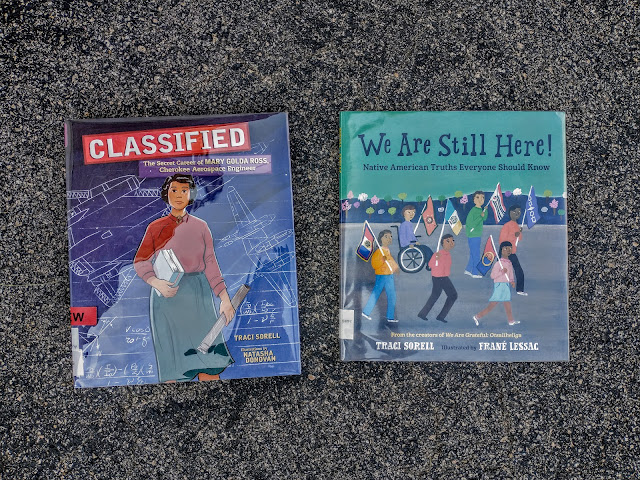
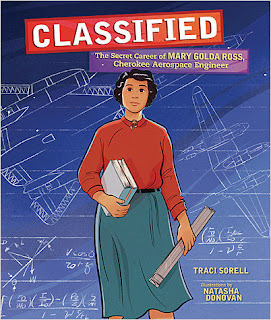
Classified: The Secret Career of Mary Golda Ross, Cherokee Aerospace Engineer by Traci Sorell, illustrated by Natasha Donovan.

This is a picture book biography of Mary Golda Ross, who grew up with a strong connection to her Cherokee tribe. As a woman in the 1920's who lived until 2008, her love of math and eventually engineering was uncommon, and she helped blaze a trail for other women and Native Americans. 

From the first page, Classified focuses in on four Cherokee values: gaining skills in all areas of life, working cooperatively with others, remaining humble when others recognize your talents, and helping ensure equal education and opportunity for all. I love how the material in the back of the book shows the syllabary, transliteration, pronunciation and English translation of each of these values. In my review here I thought of summarizing the four values, using one word each, but that doesn't really capture what the actual, translated values are. It feels more true to share the direct translation. 

Classified by Traci Sorell
Sprinkled with interesting truths about Mary Golda Ross, this biography tells us some of the work that Mary accomplished -- but much of it is still "classified." This made it a little bit difficult for me to remember the book, when I read it among a stack of contenders, and after it had been a little while between readings. What was it she did, again? There is no "one thing" that the book gives her complete credit for. However, this is the big truth -- our accomplishments are cooperative, and Mary Golda Ross apparently understood that well. Upon re-reading the book, I realized it's not the sort of picture book biography that is meant to tell you about one person so much as it is meant to teach you, through one woman's example, these four Cherokee values that she lived by. 

On my first read? Meh. On my reread? I like it a lot!

The illustrations are well done, and add to the understanding you get from the text. Simple, but not oversimplified, colorful yet still realistic, the art isn't showy, but it is solidly helpful. The backmatter of the book includes a timeline, source notes, bibliography, author's note, and the aforementioned four Cherokee values. 

This book was shortlisted for the Cybils Award in the Middle Grade Nonfiction (ages 8-12) category, and I think ages 8 and up is about right for it.  I would recommend it to kids parents and teachers who are interested in learning about other cultures and the core values that drive us! Bonus, you will also learn about women in STEM.


We Are Still Here: Native American Truths Everyone Should Know by Traci Sorell, illustrated by Frané Lessac

Another Cybils nominee in the elementary nonfiction category, We Are Still Here reminds me of a young adult graphic novel I read for the Cybils called This Place: 150 Years Retold. This Place won the Cybils award (for Young Adult Graphic Novel) back in 2019. It was so good. I can't believe I didn't review it here! But I helped to write the review of it posted here. Anyway, We Are Still Here gives readers a lot to unpack, and I was grateful for the context that I had from previously reading This Place

The premise of the picture book, We Are Still Here, is that each page is the project that a student has created to teach classmates about some aspect of indigenous people's history that still affects life today. There are twelve topics covered and they range from assimilation and allotment to language revival and sovereign resurgence. The text of We Are Still Here has very high vocabulary and a lot of information on each page, but the repeating refrain "we are still here," ties each page to the next. 

Hand-painted art sets the scene for each "presentation" and features a lot people -- presidents of the United States, children at school, and people on the street just to name a few. 

Backmatter is robust in this book, and includes more information on each of the twelve topics, a timeline from the 1870s to the 2007, a glossary, sources, an authors note. While I feel like this book packs a lot of information in, it also gives readers resources for further learning so that they can delve deeper into each of these topics. 

I really appreciate that repeating refrain which titles the book: We are still here! The more I have learned and the older I've become, the more I realize the truth of this and the obstacles that indigenous people have faced. I still have a lot to learn. When we moved to Connecticut, I enjoyed learning that "The Last of the Mohicans" -- a movie/book I've never watched/read -- was wrong. The Mohegan tribe is still here! 

I recommend this book for older elementary school kids and as a great resource to older students and adults. I have to agree with the books subtitle, it contains history that everyone should know. 

Four Fabulous New Non-fiction Picture Books


Ok friends, get your library cards ready, because today I'm telling you about more of the awesome finalists for the Cybils award that I got to read this year! They're so good!


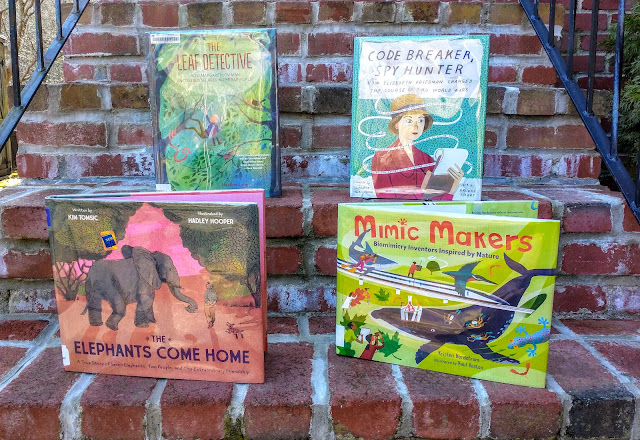
Mimic Makers: Biomimicry Inventors Inspired by Nature by Kristen Nordstrom illustrated by Paul Boston

Mimic Makers was a big hit at my house. I think all four of my kids (ages 13, 11, 8, and 4) read all or part of it. 

I know that biomimicry is a topic discussed in first/second grade classrooms because I helped my daughter with a project about biomimicry when her school was online during the pandemic. So, when I opened this book, I hoped for some fresh examples. The shinkansen is a well-known example and I was starting to roll my eyes, but then every other example in the book was something I had NOT heard about and found absolutely fascinating.

The information is presented with a clear structure, with human interest elements, and is just so fascinating that I found myself bringing the inventions up in everyday conversations I was having. I love the way inventors from around the globe were interviewed! And, you can tell from the stories shared in the book (as well as her backmatter) that the author interviewed the inventors personally.

Meticulously researched! Fabulously written! Broad appeal! When I finished reading this book I immediately wanted to gift a copy to my daughter's teacher. (And don't tell all the other books, but I pitched this one as my personal favorite to our panel of judges.) 


I really enjoyed reading this book! Of the books on the Cybils Elementary Nonfiction shortlist this year, this was the book I was most excited to read to my family. It is a beautiful story and it did make my voice catch when I read it aloud. 

The Elephants Come Home has broad appeal. My 4 year old was very interested in it. When faced with all the nominees, a 9 year old friend of the family picked it as the most appealing cover. My kids and Jacob all read it or listened to me read it. I myself loved it. The first page gets a reaction! It seems like a love-it-or-hate-it beginning and it does hook you in. Then, the writing is crystal clear. You’re guided seamlessly through the story, which is a beautiful human and animal connection story! There’s no doubt in my mind it has both kid appeal and literary merit. 

The one thing that gives me pause is the book's treatment of race. The only time race is overtly mentioned in the book, it doesn’t put Zulu people in a positive light. Race is depicted in the illustrations, but the people of color in the book are not named. When I read it aloud to kids now, I plan to point out some of the illustrations and wonder aloud what the names of the people of color are. I think they were purposely left off to keep the story simple and the writing very crisp. The writing is crisp, but it does anonymize people of color. Despite this, I still highly recommend The Elephants Come Home.  


This book was the first of the Cybils finalists that Jubilee (age 8) read this year, and she quickly asked me if I had read it yet. "It's really good," she said. 

Code Breaker, Spy Hunter tells the story of Elizebeth Friedman, who broke SO many coded messages  and invented and taught code breaking in WWI, WWII and beyond. Her work has only recently come to light because it was kept classified for years. 

Jubilee and I both liked the page that tells about Elizebeth testifying in court and proving the opposing counsel wrong when they said she was making up the answers to the decryptions she had solved. Victory! Jubilee also liked the story of her sousing out the solution to a code that involved code words and suspicious letters about dolls. I liked the tidbits about Elizebeth's personal life and dreams - the mysterious party hosted by the Friedmans in which invitations were sent in code, and the priority that Elizebeth put on her family and home life. 

The illustrations are done in colored pencil (or colored pencil style...it's so hard to tell these days with digital art making huge strides!). The images obviously contain hidden codes that it would be super fun to try and decipher. Sadly our copy was overdue at the library all too soon! We did crack the one cypher in the back of the book that is meant to be cracked, but I have a feeling that there are many more hidden messages in the illustrations.

My book club read The Woman Who Smashed Codes, a biography of Elizebeth Friedman, last year. I didn't finish it in time for our club meeting but found it interesting and recognized a lot of the details of Friedman's life from that book. However, The Woman Who Smashed Codes has over 400 pages in which to tell her story. I think it spoiled me a little bit, because I felt like the picture book left too much out. But, that's just a personal problem. 


Multi-layered digital art made this gorgeous book stand out among the forest of options, and it was a close contender for the winning spot. 

The Leaf Detective tells the story of Meg Lowman, "Canopy Meg," as she is sometimes called. She revolutionized the way that trees are studied, invented canopy walkways, and educated countless people about trees and how and why to protect them. 

One thing I loved about this book was that aside from the main text, on a leaf on each page, new insights and facts added to the narrative. For instance, before Lowman revolutionized the field, did you know that most scientists studied tall rainforest trees by chopping them down to see what the top looked like? Or sometimes they gassed the trees so that all their leaves would fall and they could study the leaves that way. I mean, that's mind blowing! Meg sewed herself a harness and hoisted herself up into the trees to study them without killing them. You go, girl!   And her work as an inventor and educator is no less inspiring, but I'll stop ranting and let you read the book.

If I read a picture book biography, I want it to impress me with facts and research as well as story and have the answer to that all-important question that I ask myself as I pretend to be a grade school boy who could be playing video games right now, "Why should I care?" Check, check, check. The Leaf Detective was a great read. 


Guest Review: Humble Pi

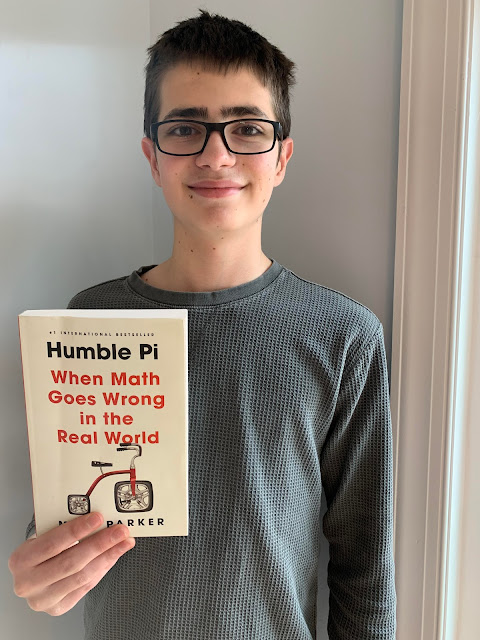
Well hello there! Today I have a guest review for you. This review comes from Spencer, who is 14 years old. I was able to obtain Spencer's review for you because his mom, Ashley, and I are good friends. Some of you may remember that Ashley used to post on Everead regularly. Take it away, Spencer!


I have a book recommendation. It's called Humble Pi. It is my absolute favorite book by a long shot. It's about math gone wrong in the real world. It showcases many mathematical problems that have occurred over the years, covering things like coding issues, 8-bit rollover errors, bridges falling, fence-post problems (Who knew the piano was a fence-post problem?), a single book's price accidentally rocketing up to $20,000,000, and a rocket activating its self-destruct system and blowing up. Matt Parker’s writing makes these math issues accessible and hilarious. You don’t have to be a math whiz to enjoy it. It's an amazing book and cannot be ignored.  So whenever you get the chance to get it, you should read it. It's amazing. 

-Spencer Bair

Thanks, Spencer! This looks like the sort of book my family would love! For anyone else looking for a copy, I'll embed a preview and link to it below. And if you're looking for more books I recommend for teens, click here and you'll see all the posts I've made about YA fiction. This next link will take you to a post I made for some of the 13 year old readers in my life.  

Humble Pi: When Math Goes Wrong in the Real World by Matt Parker 


Cybils Winners!


I'm so excited to announce the winners of the Cybils award for Elementary & Middle Grade Nonfiction!

This year I served as a Round Two judge on the Elementary & Middle Grade Nonfiction panel for the Cybils - Children's and Young Adult Bloggers Literary Awards. The awards have been going for 16 years now, and I have been volunteering in some capacity for the last 14 years -- wow! 

I have to say that I felt like the entire shortlist for the Elementary Nonfiction category was really strong. As I told my fellow panelists, I wouldn't be sad if any of these books won. I'll be reviewing each of them in the coming weeks. The Middle Grade Nonfiction category had many strong contenders, too!

Books earn the Cybils award by being exemplary in two areas: Kid Appeal and Literary Merit. We discuss and award books on these two criteria. Do kids like the book? And is the book good, from a literary standpoint?

Round one judges read all the nominated books published in the past year (October of the year prior through October of the present year) and evaluate them on Kid Appeal and Literary Merit. They narrow this list (maybe 150 books or more) down to 5-7 titles. This is the shortlist. 

Round two judges narrow the shortlist in each category down to the single winner! And that's what we have here for you today. The BEST nonfiction book for kids ages 5-8 in the Elementary nonfiction category, and the best nonfiction book for kids ages 8-12 in the Middle Grade category.

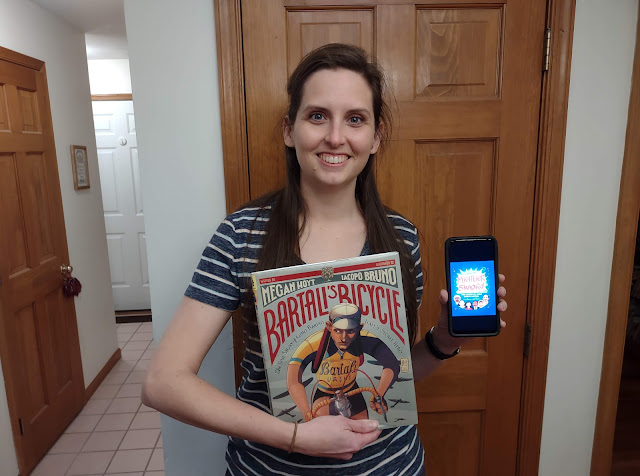
written by Megan Hoyt illustrated by Iacopo Bruno

This is a picture book biography of Gino Bartali that is so beautiful and inspiring! 

As one of my fellow panelists pointed out, riding a bike is something kids can relate to in a big way, and that's what Gino Bartali was famous for . . . at least at first. When it came to cycling, he trained persistently and eventually won the Tour de France! But when Nazis invaded Italy, Gino became another kind of hero. He used his cycling skills to protect and preserve the lives of those around him. And the humility he exhibited throughout his life and despite his achievements is memorialized here. 

In deciding between Bartali's Bicycle and some of our other strong contenders, panelists talked about the gorgeous, dynamic illustrations of Iacopo Bruno. Guys, I know "we don't talk about Bruno," but this art is top notch! Each page conveys movement and has an interesting, fresh layout. 

Materials at the end of the book include a letter to readers from Gino Bartali's granddaughter, a timeline, and a full page of sources. 

Definitely give this book a read. As soon as I finished it, I thought I had better share it with the most avid cyclist that I know. I'm sure you'll find someone to share it with, too. When looking at a picture book, you have to consider, is an adult going to want to read this over and over? Is a kid going to want to read it? Bartali's Bicycle will definitely appeal to ages 5+ and stand up to repeated reading.


 by Rochelle Melander, illustrated by Melina Ontiveros

Mightier than the Sword was a little bit tricky for some of us judges to get our hands on! It was published by a small press, and so it wasn't available in my library. However, if your library has hoopla (kind of like the Netflix of ebooks and music for libraries?), then you can find this title there. And it is absolutely worth finding!

If I'm totally honest, I wasn't particularly looking forward to reading a bunch of bios of writers. It is really easy for this type of book to become same-samey. Maybe you turn to it for one person, but you'll never read it cover to cover. WRONG! I absolutely read Mightier than the Sword from cover to cover and it was not even a chore. It was delightful! 

For one thing, the writing is engaging and fantastic. (Thank goodness! To have sub-par writing in a book about so many writers would be embarrassing.) Each person's story is brought to life with interesting details and relevant quotes. And then, if that wasn't enough, there are little sidebars or cameos of other relevant writers in each chapter. The organization of the book made it really interesting to me, as well. Each chapter is a writer's biography and they are ordered by year of the writer's birth. So, the book as a whole becomes something of a history book, as you go along. 

I'm reading A Little History of the World by E.H. Gombrich with my daughter Jubilee right now -- we're just taking a chapter at a time on nights when we can squeeze it in. It's great. But honestly, I can't wait to read Mightier than the Sword with her! She is going to eat it up. Especially because she has some aspirations to writing, and each chapter ends with writing prompts and suggestions. 

Another engaging facet of the book is the illustrations. Each writer and each sidebar gets a portrait by Melina Ontiveros. For the names I didn't already recognize, it was fun to try to puzzle out who this person would be based on the small items included in their portrait. 

As a group, we round two judges loved that it was a diverse group of writers highlighted. Not only were writers from a variety of homelands and races, but also diverse through time, as I've mentioned, and they are diversely famous -- some of them are famous for being writers (Shakespeare is profiled), but others are more famous for other work they've done (Florence Nightingale, for instance). And still others of them weren't already known to me. Mightier than the Sword made learning a pleasure. 

One of my fellow panelists was formerly a teacher and she was very excited about the potential for classrooms to use this book. It would be very easy to read excerpts, and of course the suggested writing activities would connect to teachers and students well, too. 

I hope winning the Cybils award for Middle Grade Nonfiction shines some more light on this book, because it deserves to be found! 

A full list of this year's Cybils winners in all categories can be found here

The Faithful Spy: Dietrich Bonhoeffer and the Plot to Kill Hitler

The Faithful Spy: Dietrich Bonhoeffer and the Plot to Kill Hitler by John Hendrix

I just wanted to record some quick thoughts on this book... 

I've been meaning to read it for a while now! The Faithful Spy won the Cybils award in the high school non-fiction category in 2018, and got loads of good buzz before and after. 

I started to read the massive biography of Dietrich Bonhoeffer by Eric Metaxas that came out a decade ago, but had to return it to the library and never finished. I figured The Faithful Spy would fill me in on what I had missed. 

I enjoyed reading The Faithful Spy, but I do wish I had time to read that huuuuuge biography that I had to return too soon. I liked the beginning of that one a lot -- it was full of quotes from primary sources. This one at least gave me a sketch of Bonhoeffer's life. It's very well done, with a lot of text, a lot of illustrations. It's not quite a graphic novel and not quite NOT a graphic novel. I like the way the Cybils team described the art as a mix of political cartoons and Mad Magazine. Their review is here.

Overall, The Faithful Spy left me feeling somber, and took me a little more than an evening to read. It gave me some interesting philosophy and religion concepts to think about. Recommended to those who are interested. 


The Beatryce Prophecy

The Beatryce Prophecy by Kate DiCamillo, illustrated by Sophie Blackall

Well, when I hear that Kate DiCamillo has written a new book, I'm interested. She has been writing amazing books for a long time. Maybe her most famous is Because of Winn-Dixie? The first book of hers that I read was The Tale of Despereaux, for which she won a Newbery Medal. 

The Beatryce Prophecy is her newest book, and it was illustrated by Sophie Blackall, who recently won two Caldecott Medals. 

The Beatryce Prophecy is beautifully written and illustrated. Much like the other novels by DiCamillo that I have read, there's quite a bit of danger and suspense! However, I wouldn't call the book fast-paced. Like its protagonists, who walk through the woods, this story takes its time. Each one of our favorite characters has a tragic backstory. 

In the medieval countryside we meet Answelica, an ill-tempered goat, and Beatryce, a girl who can't remember much but can read, which is forbidden. We meet Brother Edik, a monk who doesn't quite fit in at the monastery, and Jack Dory who lost his parents to highwaymen. As their stories begin to intertwine and weave around one another's, they become happier. 

This is a realistic fiction book marketed to 8-12 year olds -- what is called a middle grade book. It seems to me that with its meaty plot and foreshadowing, combined with the simple writing style (which doesn't skimp on big vocabulary) and beautiful illustrations, it has a lot of the qualities that are loved by kids who love graphic novels. My kids read and enjoyed it, as did I. I received an advance reading copy of the book.


Fall (in-love) Reading

This fall I read two books about falling in love. Both had some good meat on the bones of the romance, which made them enjoyable not only as romances but as stories of their time. 

The Rosie Project by Graeme Simsion 

Our protagonist Don is a Australian genetics professor with a side project: find his ideal wife. He crafts an elaborate survey to help him, and the results are comical. He also volunteers to help Rosie with her own project: uncovering the identity of her biological father. Two projects soon become one and the same. I enjoyed reading this book, which was very popular a few years back. I had tried to read it at the height of its popularity, but put it down due to language and sexual themes. I picked it back up again and enjoyed the story. It is a well paced book with laugh-out-loud moments and quiet memorable moments, too. The characters grow in some inspiring ways, and I won't soon forget our main cast. I'm interested to watch the movie, which hasn't been made yet, but is in talks. 


The Giver of Stars by Jojo Moyes 

I read this book about a horseback library program in Depression-era Kentucky for book club. Our main character, Alice, has married for love AND money, only to find that neither one is worth having to put up with her insufferable father-in-law. She escapes by volunteering to take books to country folk over the hills, and makes friends and finds true love along the way. This book was expertly plotted. I particularly liked how the prologue set the readers expectation for the book. In the flow of the larger narrative, coming back to the prologue rather than having that chapter set in the middle of the book is ingenious. The characters are memorable, well developed, and varied. The book wraps up in a satisfactory way, but one or two questions that the author leaves for readers to answer made for a lively book club discussion.


Just for fun, here's a photo of me and my true love. 
 

The Rithmatist by Brandon Sanderson

The Rithmatist by Brandon Sanderson 

This book came out in 2013, so I think we owned a signed hardback copy for 8 years before I finally read it. Brandon Sanderson's YA Reckoners series is my favorite of his books, so when 13-year-old Benjamin was rolling his eyes at me for never having read The Rithmatist (also for the YA market), I decided to get my act together. I enjoyed it. It was entertaining, and eventually pretty suspenseful. 

The Rithmatist is the story of our protagonist, Joel, who lives in a steampunk world where the USA is a collection of islands and some people can make chalk pictures come to life.  Joel is spending all his time wishing he had been chosen as one of these special people -- he wants to be a Rithmatist. Pretty soon, however, young Rithmatists start disappearing, apparently attacked by one of their own, a mysterious Rithmatist. Joel inserts himself into the investigation and his summer that looked boring at the outset gets very busy indeed. 

Sanderson did a nice job with this book -- solid characters with various motivations and complex backgrounds, a plot with increasing complexity and pacing that starts slow and speeds up by degrees until you're up late because you can't put it down. I really liked how Joel and Melody's friendship developed, and found it realistic and just a lot of fun to see them go from nothing to having inside jokes. There is some violence in the book: it's a mystery about the disappearance (kidnapping? murder?) of high schoolers. I felt like Sanderson kept it solidly PG-13. Ben McSweeney's illustrations definitely added to the book and made it work. All the chalk pictures and the occasional spot art were anchors for me when otherwise I would have been lost, thinking about this magic system.

Jacob warned me when I was starting it that "Brandon says he regrets setting it up for a sequel" because other books and projects have since filled his time. So I knew going in that it would have some unresolved threads at the end of the book. Knowing that was enough for me, and I'm satisfied with the ending. 

I did sometimes feel the book was a little repetitive. Sanderson really wanted to make sure you knew what was going on. Occasionally I felt the writing condescended a little bit, for the sake of clarity. Like, the bad guy reveals himself and then Joel thinks, in a separate sentence, 'he has to be stopped.' That sort of thing.  That said, I didn't really mind because I was reading it for the entertainment and the enjoyment of the story and the story was, indeed, always clear. 

I'm glad I read this one, and only sorry I waited so long to read it! Recommended.

Alysa's Summer Reading

Hello! I did do some good reading this summer that I want to share with you. 

Race the Sands by Sarah Beth Durst 

My book club read this fantasy novel and it was enjoyed by all. A couple of us thought we were reading a YA fantasy book, but it turns out this one is marketed to adults. The main premise is that in Bekar, people live good lives hoping for rebirth as a human or auger. The worst thing to be reborn as is a kehok - a monster. The kehoks are dangerous, but that doesn't stop people from racing them! We follow a trainer, a rider, and the political turmoil in the country. 

Our group agreed that the worldbuilding and characters were excellent. It was so refreshing not to have a love triangle! And the abundance of strong female characters was awesome. There was a fair bit of violence in the book, but prrrrobably definitely less than The Hunger Games or something. No bedroom scenes. I was so into the book that I ended up telling my kids all the plot of it, just because my mind was so thoroughly engrossed. I definitely filtered out some of the violence in my retelling though, ha! Recommended. 

The Code of the Woosters by P.G. Wodehouse

This was my pick for book club this summer. It met with mixed reviews in the club, partly because it came on the heels of Race the Sands, and Bertie Wooster is very down on Angela Basset throughout! Those who liked it really liked it, and those who didn't, didn't. I find that's pretty typical of humor books. 

The Code of the Woosters is a middle book in the Jeeves and Wooster series. It was the most accessible title at the local libraries, which is why I chose it over Right Ho, Jeeves, which is probably my favorite (Right Ho, Jeeves is especially good on audio). Anyway, the series follows young bachelor Bertie Wooster in London in the 1930's, who is constantly getting into tight spots and requiring the ingenious brain of his valet, Jeeves, to get him out of trouble. This installment details Bertie's misadventures with a collectible silver cow creamer, blackmail, rifts between lovers that could have dire consequences for him, and more. I noticed it was on a list of recommended classics for eighth graders, and I could get behind that. If you want to dip your toes into the Jeeves and Bertie world, you can always look up some of the old episodes of the BBC TV adaptation on YouTube for a taste. 


How Not to Die by Michael Greger, M.D., FACLM

This thick volume details the research on nutrition in health for a number of scenarios. There are two main sections in the book: the first section has chapters organized by disease, the second section has chapters organized by types of foods. Chapters in section one include How Not to Die from Suicidal Depression, How Not to Die from Breast Cancer, How Not to Die from Diabetes and many more. Chapters in section two include Spices, Cruciferous Vegetables, Berries and many more. 

I became interested in reading this book because I did an internet search for "how to lower your estrogen" and the search results I found referenced the book multiple times. Obviously, I thought, it would be a better source of complete information. And I was right, there really is so much info in the book. The author has made a living of studying medical research findings and publishing them in layman's terms. He runs the website nutritionfacts.org. His grandmother's life was saved when she changed her diet in her old age, and he shares that amazing story in the beginning of the book. 

I didn't read the book cover-to-cover, but I did read large swaths of it, and found it fascinating and motivating. I shared enough passages of it with Benjamin that he took it up himself and started sharing passages back with me. We've both been eating healthier since. I recommend it, if you're interested! 

Oh, I also checked out the How Not to Die Cookbook from my library. It was alright. I've learned how to make vegetable broth now. I took down a few of recipes before I returned it: the one for Veggie broth, one for a dish of beans, rice and broccoli, and the last for a dairy-free "macaroni and cheese" dish.  My favorite healthy eating cookbook is still The Smoothie Project by Catherine McCord.


The No. 1 Ladies Detective Agency by Alexander McCall Smith

This was the August pick for book club, and I had read it for another book club in another state some years ago. I remembered liking it, and I remembered all of the worst and most violent parts. So, I'm happy to say that I really enjoyed the reread!

This is the first in a series of detective novels set in Botswana. The author helps us get to know our lady detective, Mma Ramotswe, explores her country and family history, and takes us on several of her cases. 

Some of the cases are lighthearted and some are heavier, and the book strikes a good balance. I definitely categorize it as "for grownups," but then again as a teen I read a lot of Agatha Christie. Anyway, since I had read the book before and many of the cases outcomes came back to mind as I was reading, I was able to really enjoy the superb writing in this book and appreciate some of the humor and foreshadowing that I couldn't enjoy last time, because I was on the edge of my seat, metaphorically. I might read more in the series . . .There are apparently 21 books in the series now, wow. 

This is another series (like Jeeves and Wooster, above) that has been made into a television show. After reading the book I did look up the first episode of the show on YouTube, just to satisfy myself that I was pronouncing Mma correctly (and to pass the time as I folded laundry). Unfortunately I can't recommend the series, because it makes the main characters into buffoons. I was offended, on behalf of Mma Ramotswe. (Incidentally, Bertie Wooster is also a buffoon, but he is meant to be a buffoon.)

When Stars Are Scattered

When Stars Are Scattered by Victoria Jamieson and Omar Mohamed
National Book Award Finalist, Winner of Cybils Award (Elementary/Middle Grade Graphic Novels)

Omar and his brother Hassan live in a refugee camp and they have ever since they can remember. This graphic novel shows their life in the camp, Omar's schooling, Hassan's struggles because of his disability, and their relationships and ups and downs of life. 

Coming from award winning graphic novelist, Victoria Jamieson (known for the Newbery-winning Roller Girl and All's Faire in Middle School), I expected the book to be well written and drawn, and it was. It's also an amazing story, and we have Omar Mohamed to thank for that. There were definitely moments when my eyes got misty.

This book is well suited to the upper elementary and middle school markets. I recently read Walk Toward the Rising Sun, a memoir written for middle and high school students, and I found that one richer in details but it also had some swearing and violence that When Stars Are Scattered doesn't have. Each was well suited to its audience.     

Benjamin (age 12) also read When Stars Are Scattered, and says that it's good. He recommends it for fans of Home of the Brave by Katherine Applegate, which his class read in 6th grade. 

A Gentleman in Moscow

A Gentleman in Moscow by Amor Towles

The book opens with the transcript of a trial, and answers this question: What will become of a gentleman in Moscow? Specifically, what will the new communist Russian government do with the Count, His Excellency Alexander Ilyich Rostov, son of the Grand Duke, now that the Tsar has been deposed?  Before the beginning of Chapter 1, we learn that the Count is sentenced to house arrest in the Metropol Hotel.  

I really loved this book, and it reminded me of many of my favorite books. I loved the characters -- they felt as real to me as the March sisters in Little Women. I loved the setting and learning a little bit more about Russian history, because my brother Ransom speaks Russian and has spent time in Ukraine. I loved Count Rostov's noblesse oblige attitude (a la The Scarlet Pimpernel). And maybe you should imagine Frances Hodgson Burnett's classic, A Little Princess, but with a grown man?

I don't want to say much about the plot. I myself loved knowing nothing about where it was going as I went along. I would recommend this book for adults, but if my teen wanted to read it I wouldn't mind. 

This is the sort of book that makes me wish I spoke five languages, had read lots of classic Russian literature, and watched all of Humphrey Bogart's films. 

One of my favorite scenes in the book is the description of the twice-tolling clock and the purpose for which it was commissioned. And, of course, the hide-and-seek game in the Count's study. Ah, now that I'm thinking of favorite scenes, there are too many! 

I gave Ransom this book for his birthday. I don't know if anything else I can say could recommend the book more highly. 

Have you read it? Please tell me your favorite parts. I read it for a zoom book club, but then I missed the discussion, so I'm itching to discuss. 

I didn't take this photo in Moscow, but I did take it in the snow!

Related Posts Plugin for WordPress, Blogger...