Quantcast

Unbroken (The Young Adult Adaptation): An Olympian's Journey from Airman to Castaway to Captive

Unbroken (The Young Adult Adaptation): An Olympian's Journey from Airman to Castaway to Captive
by Laura Hillenbrand

One of the reading goals I've made this year is to read the books that my son is reading in his high school English class. So, that's what gave me the guts to finally pick up Unbroken

Unbroken is a biography of Louis Zamperini who as a kid was a trouble maker, as a young adult was an Olympic runner and who then enlisted and fought in World War II where he was lost at sea and became a prisoner of war. His life is truly amazing and inspiring to read about, and it's no wonder this book was chosen for the Honors English unit on survival. He survived not only these things, but post-war difficulties as well. 

The original edition of the book is subtitled "A story of survival, resilience, and redemption." An apt description! 

I first heard about Unbroken when my book club read it ten or eleven years ago. For one reason or another I couldn't read the book at the time, but I attended the discussion. It sounded like an amazing story, but maybe a bit too graphic or disturbing for me -- some of my book club friends had said it was very detailed about the violence that Zamperini experienced as a prisoner of war, and shared some of the truly disturbing cruelty he faced, so I was hesitant to read the book, despite their reassurances that it was worth it.

I was glad to see that the class was reading the young adult adaptation of the book. I looked up what the differences were between the original edition and the young adult edition, and the version I read was shorter, had fewer detailed descriptions of violence and fewer details about Zamperini's alcoholism after the war. Perfect for me. 

I had just read Life of Pi, so reading the story of Louis Zamperini being lost at sea was particularly heartwrenching and fascinating. How I wished that he had known sharks are edible! My heart is still a little bit crushed over that detail of his ordeal. After reading Unbroken, I read Mrs. Frisby and the Rats of NIMH and saw some striking parallels, but that's a post for another day.

I'm happy to recommend this book for teens and adults. It has just about everything you could want from a biography. It has moments of daring, moments of heartbreak, tender moments, funny moments and miracles. It is beautifully written and meticulously researched, never drags along when giving context but somehow perfectly tells the story in a way that incorporates all the surrounding details you need to know. I'd like to own a copy of myself. I've lost track of how many small moments from the book I have told to friends and family members. It has been a little while since I finished it, and it continues to be on my mind. 

Just yesterday I read the famous poem Invictus by William Ernest Henley and thought, "That's Louis Zamperini." A friend mentioned that her son is doing some troublemaking, and I thought, "There's hope. Just think of Louis Zamperini." It really is an inspiring book, and worth the read.

Life of Pi

Such a famous book! I have been meaning to read this one for a long time. Ashlee chose it for our book club book this month, so I finally read it.

A far cry from Pi's circumstances!

Life of Pi is a book about a young man named Piscine, who goes by Pi. His father is a zookeeper, and when the family decides to move from India to Canada, they emigrate on the cargo ship that is bringing some of their animals to zoos in the U.S. and Canada. Disaster strikes and (as shown on the cover of most editions of the book) that's how Pi ends up stranded in a lifeboat with a tiger. But as the title suggests, there is more to the story than just Pi's time on the lifeboat. It's really the story of his life.

I really enjoyed reading this book. The writing was very well done -- I was surprised, disgusted, moved and provoked to deep thoughts. Knowing that I was going to get to discuss the book with friends was icing on the cake. 

Our discussion was rich - there is plenty of meat in this book (pun intended!) for talking about the human experience and I can see why its considered a classic. Ashlee, who chose the book, has read it many times over and always finds something new in it, which I can relate to! I've only read it once, but already in our discussion I was finding new things to think about and angles I hadn't considered. 

The book was also made into a movie in 2012. I hear they did a really great job, but that of course the book is better. So, I might watch it now that I've read the book. 

In some ways this book reminded me of The Alchemist by Paolo Coelho, and the Odyssey. All three  stories have direct applications of the hero's journey specifically to life's journey in general.  

Levi (who is in 7th grade) said he was interested in reading it, and I wouldn't have any problem with that. I don't think it would appeal to readers much younger than 7th grade, but I could be wrong. The book has a high vocabulary and plenty of survival violence and peril. The story incorporated more religion than I was expecting, no swearing or sexual content, except to talk briefly about animal's needs to reproduce. It's definitely the sort of thing I could see English teachers enjoying teaching and book clubs enjoying discussing! We had a good time -- and Ashlee brought bananas and coconut cream pie. 


Ride On by Faith Erin Hicks

Ride On by Faith Erin Hicks

Horse riding lesson


I really enjoyed this graphic novel! I picked it up from the library because it's by Faith Erin Hicks and I have liked her books in the past (One Year at Ellsmere, and Friends with Boys especially!) There was a great ensemble cast to this book. Although the front cover has just one of the main characters on it, (kind of two, if you count the horse, I suppose!) there are a bunch of awesome characters in this book. 

I was never super into horse books (it was all about the Babysitters Club, for me!) but that didn't stand in the way of my enjoyment of this book. My dad loves horses and our family owned a few now and then (see the picture above). Even though I didn't ever consider myself a horse girl, many sweet moments, some silliness, and some real conflicts made the book compelling. It's realistic fiction.

Norrie is always stirring up drama.

Sam's brothers tease him like crazy.

What happened with Victoria to make her change stables?

I loved all the positive sibling relationships in this book. Victoria's sweet older sister, Norrie's sweet older brother, even Sam's brother's eventually have some sweet moments.  I loved that Victoria's mom was an accountant, haha! Yeah, accountants know better than to buy horses.

Ride On is set in middle school, and as far as romance goes, there is just the barest hint of a crush. It's a super sweet book. Some themes of Ride On are friendship, growing apart or growing closer, what it means to you to be around a good friend, working hard, competing. I loved it, and my kids did, too. 

Ride On on Amazon

Have you read it? What did you think?

The Invisible Life of Addie LaRue

For book club, I read The Invisible Life of Addie LaRue by V. E. Schwab. I did not love it. 

Addie LaRue is a young woman in a time that is unkind to young women. She has always loved the local unmarried woman and aspires to be her. However, her father arranges a marriage for her. In a last-ditch effort to avoid the wedding, Addie enters into an agreement with a higher power, agreeing to live a life where once she has gone out of sight of someone, she will go out of mind, too. She can move through life forever: immortality! But no one will remember her, even from one interaction to the next. 

The writing was good. The story really pulled me along! I enjoy high-concept books and movies, and this one did a particularly good job exploring at least one branch of "Hmm, what would that actually be like?" I just didn't like Addie. I found it pretty hard to relate to her in most cases. I vacillated between not really liking Addie and really not liking Addie. 

Clare and I tried on some clothes recently.
Addie LaRue steals all her clothes because ...she can? ...she has to? 
The book made for an interesting discussion, especially because Tara helped us along. She hadn't read the book but wanted to hear about it and form conclusions about it, so she asked lots of thoughtful questions. We discussed morality and relationships and mental health and more. 

So, I find myself ambivalent about the book. I was complaining about it to my husband Jacob about three quarters of the way through -- how the characters were all ridiculous and made the worst possible choices all the time. He reminded me that I didn't have to finish, to which I responded, "Yeah...but I think I want to." I knew that finishing the story via an online summary wouldn't answer my deepest questions about it, and that not finishing wouldn't either. I disliked pretty much all the characters and disliked the way the author seemed to buy in to what I consider Hollywood tropes: sex, drugs . . . rock and roll? But the author did raise interesting questions about time, morality, relationships, what people want out of life, etc. So, though I don't hesitate to put a book down when I hate it, this one walked right along that line, pretty much start to finish. Ha!

Have you read it? I'd love to know what you think. I'm writing this a few months after reading the book, so if it's been a while for you, too, tell me what stuck with you.


Two Recommended Native American Non-fiction Picture Books


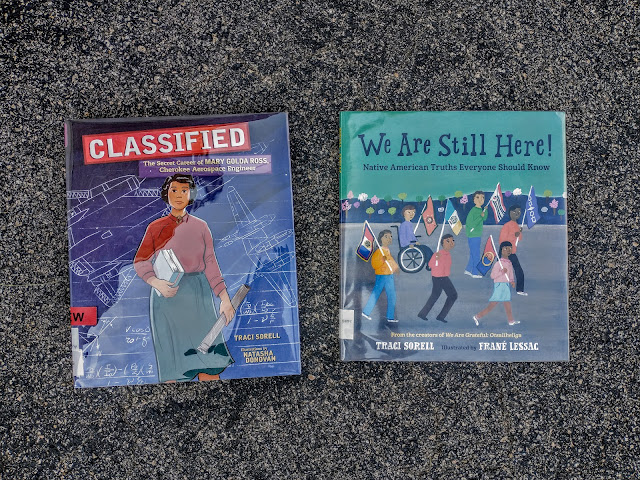
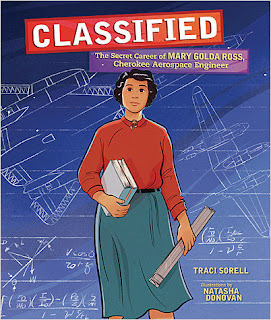
Classified: The Secret Career of Mary Golda Ross, Cherokee Aerospace Engineer by Traci Sorell, illustrated by Natasha Donovan.

This is a picture book biography of Mary Golda Ross, who grew up with a strong connection to her Cherokee tribe. As a woman in the 1920's who lived until 2008, her love of math and eventually engineering was uncommon, and she helped blaze a trail for other women and Native Americans. 

From the first page, Classified focuses in on four Cherokee values: gaining skills in all areas of life, working cooperatively with others, remaining humble when others recognize your talents, and helping ensure equal education and opportunity for all. I love how the material in the back of the book shows the syllabary, transliteration, pronunciation and English translation of each of these values. In my review here I thought of summarizing the four values, using one word each, but that doesn't really capture what the actual, translated values are. It feels more true to share the direct translation. 

Classified by Traci Sorell
Sprinkled with interesting truths about Mary Golda Ross, this biography tells us some of the work that Mary accomplished -- but much of it is still "classified." This made it a little bit difficult for me to remember the book, when I read it among a stack of contenders, and after it had been a little while between readings. What was it she did, again? There is no "one thing" that the book gives her complete credit for. However, this is the big truth -- our accomplishments are cooperative, and Mary Golda Ross apparently understood that well. Upon re-reading the book, I realized it's not the sort of picture book biography that is meant to tell you about one person so much as it is meant to teach you, through one woman's example, these four Cherokee values that she lived by. 

On my first read? Meh. On my reread? I like it a lot!

The illustrations are well done, and add to the understanding you get from the text. Simple, but not oversimplified, colorful yet still realistic, the art isn't showy, but it is solidly helpful. The backmatter of the book includes a timeline, source notes, bibliography, author's note, and the aforementioned four Cherokee values. 

This book was shortlisted for the Cybils Award in the Middle Grade Nonfiction (ages 8-12) category, and I think ages 8 and up is about right for it.  I would recommend it to kids parents and teachers who are interested in learning about other cultures and the core values that drive us! Bonus, you will also learn about women in STEM.


We Are Still Here: Native American Truths Everyone Should Know by Traci Sorell, illustrated by Frané Lessac

Another Cybils nominee in the elementary nonfiction category, We Are Still Here reminds me of a young adult graphic novel I read for the Cybils called This Place: 150 Years Retold. This Place won the Cybils award (for Young Adult Graphic Novel) back in 2019. It was so good. I can't believe I didn't review it here! But I helped to write the review of it posted here. Anyway, We Are Still Here gives readers a lot to unpack, and I was grateful for the context that I had from previously reading This Place

The premise of the picture book, We Are Still Here, is that each page is the project that a student has created to teach classmates about some aspect of indigenous people's history that still affects life today. There are twelve topics covered and they range from assimilation and allotment to language revival and sovereign resurgence. The text of We Are Still Here has very high vocabulary and a lot of information on each page, but the repeating refrain "we are still here," ties each page to the next. 

Hand-painted art sets the scene for each "presentation" and features a lot people -- presidents of the United States, children at school, and people on the street just to name a few. 

Backmatter is robust in this book, and includes more information on each of the twelve topics, a timeline from the 1870s to the 2007, a glossary, sources, an authors note. While I feel like this book packs a lot of information in, it also gives readers resources for further learning so that they can delve deeper into each of these topics. 

I really appreciate that repeating refrain which titles the book: We are still here! The more I have learned and the older I've become, the more I realize the truth of this and the obstacles that indigenous people have faced. I still have a lot to learn. When we moved to Connecticut, I enjoyed learning that "The Last of the Mohicans" -- a movie/book I've never watched/read -- was wrong. The Mohegan tribe is still here! 

I recommend this book for older elementary school kids and as a great resource to older students and adults. I have to agree with the books subtitle, it contains history that everyone should know. 

Four Fabulous New Non-fiction Picture Books


Ok friends, get your library cards ready, because today I'm telling you about more of the awesome finalists for the Cybils award that I got to read this year! They're so good!


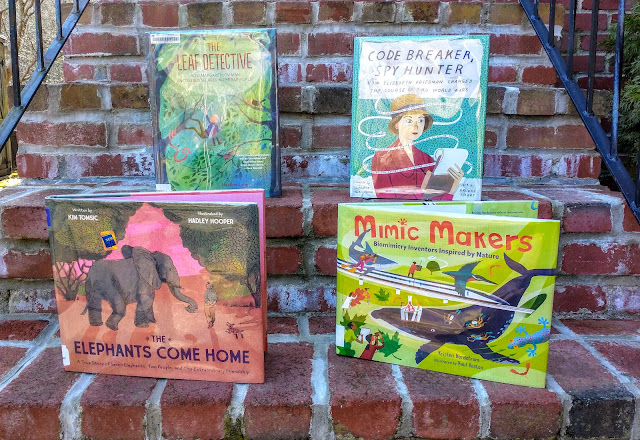
Mimic Makers: Biomimicry Inventors Inspired by Nature by Kristen Nordstrom illustrated by Paul Boston

Mimic Makers was a big hit at my house. I think all four of my kids (ages 13, 11, 8, and 4) read all or part of it. 

I know that biomimicry is a topic discussed in first/second grade classrooms because I helped my daughter with a project about biomimicry when her school was online during the pandemic. So, when I opened this book, I hoped for some fresh examples. The shinkansen is a well-known example and I was starting to roll my eyes, but then every other example in the book was something I had NOT heard about and found absolutely fascinating.

The information is presented with a clear structure, with human interest elements, and is just so fascinating that I found myself bringing the inventions up in everyday conversations I was having. I love the way inventors from around the globe were interviewed! And, you can tell from the stories shared in the book (as well as her backmatter) that the author interviewed the inventors personally.

Meticulously researched! Fabulously written! Broad appeal! When I finished reading this book I immediately wanted to gift a copy to my daughter's teacher. (And don't tell all the other books, but I pitched this one as my personal favorite to our panel of judges.) 


I really enjoyed reading this book! Of the books on the Cybils Elementary Nonfiction shortlist this year, this was the book I was most excited to read to my family. It is a beautiful story and it did make my voice catch when I read it aloud. 

The Elephants Come Home has broad appeal. My 4 year old was very interested in it. When faced with all the nominees, a 9 year old friend of the family picked it as the most appealing cover. My kids and Jacob all read it or listened to me read it. I myself loved it. The first page gets a reaction! It seems like a love-it-or-hate-it beginning and it does hook you in. Then, the writing is crystal clear. You’re guided seamlessly through the story, which is a beautiful human and animal connection story! There’s no doubt in my mind it has both kid appeal and literary merit. 

The one thing that gives me pause is the book's treatment of race. The only time race is overtly mentioned in the book, it doesn’t put Zulu people in a positive light. Race is depicted in the illustrations, but the people of color in the book are not named. When I read it aloud to kids now, I plan to point out some of the illustrations and wonder aloud what the names of the people of color are. I think they were purposely left off to keep the story simple and the writing very crisp. The writing is crisp, but it does anonymize people of color. Despite this, I still highly recommend The Elephants Come Home.  


This book was the first of the Cybils finalists that Jubilee (age 8) read this year, and she quickly asked me if I had read it yet. "It's really good," she said. 

Code Breaker, Spy Hunter tells the story of Elizebeth Friedman, who broke SO many coded messages  and invented and taught code breaking in WWI, WWII and beyond. Her work has only recently come to light because it was kept classified for years. 

Jubilee and I both liked the page that tells about Elizebeth testifying in court and proving the opposing counsel wrong when they said she was making up the answers to the decryptions she had solved. Victory! Jubilee also liked the story of her sousing out the solution to a code that involved code words and suspicious letters about dolls. I liked the tidbits about Elizebeth's personal life and dreams - the mysterious party hosted by the Friedmans in which invitations were sent in code, and the priority that Elizebeth put on her family and home life. 

The illustrations are done in colored pencil (or colored pencil style...it's so hard to tell these days with digital art making huge strides!). The images obviously contain hidden codes that it would be super fun to try and decipher. Sadly our copy was overdue at the library all too soon! We did crack the one cypher in the back of the book that is meant to be cracked, but I have a feeling that there are many more hidden messages in the illustrations.

My book club read The Woman Who Smashed Codes, a biography of Elizebeth Friedman, last year. I didn't finish it in time for our club meeting but found it interesting and recognized a lot of the details of Friedman's life from that book. However, The Woman Who Smashed Codes has over 400 pages in which to tell her story. I think it spoiled me a little bit, because I felt like the picture book left too much out. But, that's just a personal problem. 


Multi-layered digital art made this gorgeous book stand out among the forest of options, and it was a close contender for the winning spot. 

The Leaf Detective tells the story of Meg Lowman, "Canopy Meg," as she is sometimes called. She revolutionized the way that trees are studied, invented canopy walkways, and educated countless people about trees and how and why to protect them. 

One thing I loved about this book was that aside from the main text, on a leaf on each page, new insights and facts added to the narrative. For instance, before Lowman revolutionized the field, did you know that most scientists studied tall rainforest trees by chopping them down to see what the top looked like? Or sometimes they gassed the trees so that all their leaves would fall and they could study the leaves that way. I mean, that's mind blowing! Meg sewed herself a harness and hoisted herself up into the trees to study them without killing them. You go, girl!   And her work as an inventor and educator is no less inspiring, but I'll stop ranting and let you read the book.

If I read a picture book biography, I want it to impress me with facts and research as well as story and have the answer to that all-important question that I ask myself as I pretend to be a grade school boy who could be playing video games right now, "Why should I care?" Check, check, check. The Leaf Detective was a great read. 


Guest Review: Humble Pi

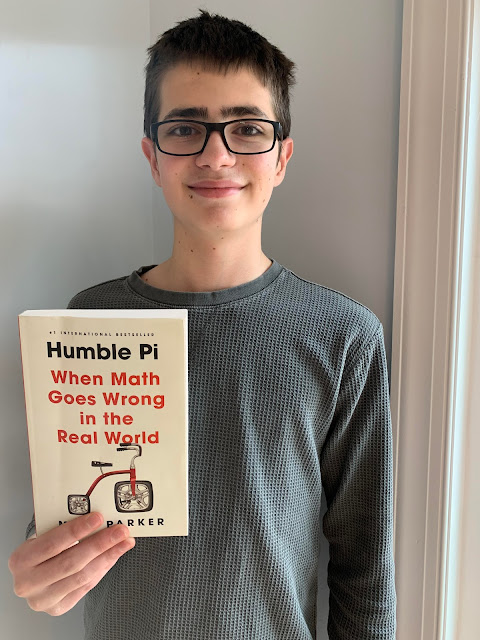
Well hello there! Today I have a guest review for you. This review comes from Spencer, who is 14 years old. I was able to obtain Spencer's review for you because his mom, Ashley, and I are good friends. Some of you may remember that Ashley used to post on Everead regularly. Take it away, Spencer!


I have a book recommendation. It's called Humble Pi. It is my absolute favorite book by a long shot. It's about math gone wrong in the real world. It showcases many mathematical problems that have occurred over the years, covering things like coding issues, 8-bit rollover errors, bridges falling, fence-post problems (Who knew the piano was a fence-post problem?), a single book's price accidentally rocketing up to $20,000,000, and a rocket activating its self-destruct system and blowing up. Matt Parker’s writing makes these math issues accessible and hilarious. You don’t have to be a math whiz to enjoy it. It's an amazing book and cannot be ignored.  So whenever you get the chance to get it, you should read it. It's amazing. 

-Spencer Bair

Thanks, Spencer! This looks like the sort of book my family would love! For anyone else looking for a copy, I'll embed a preview and link to it below. And if you're looking for more books I recommend for teens, click here and you'll see all the posts I've made about YA fiction. This next link will take you to a post I made for some of the 13 year old readers in my life.  

Humble Pi: When Math Goes Wrong in the Real World by Matt Parker 


Related Posts Plugin for WordPress, Blogger...